
STOREBASE INSIGHTS · Multi-location operations
Choosing store software: test a workflow before comparing prices
Compare multi-location store software with a complete workflow, not a feature checklist alone. Test whether one employee can enter a transaction, another can review it, and the team can correct an exception and verify the result. Establish that before deciding whether the price is worthwhile.

On this page
A feature does not mean the work is finished
An easy entry screen may still lead to a difficult review process. Many reports are of little use if staff cannot create the underlying records. Compare the path from entry to verification rather than the number of screens.
Design a small pilot
| Test | Evidence to collect |
|---|---|
| Normal transaction | Staff can enter and find it without assistance |
| Incorrect entry | The correction and its reason can be explained |
| Another role or store | Access matches the actual responsibility |
Use sample data first and minimize personal information. Set an owner, an end date and pass criteria. If the business owner performs the difficult clicks, the test has not demonstrated staff usability.
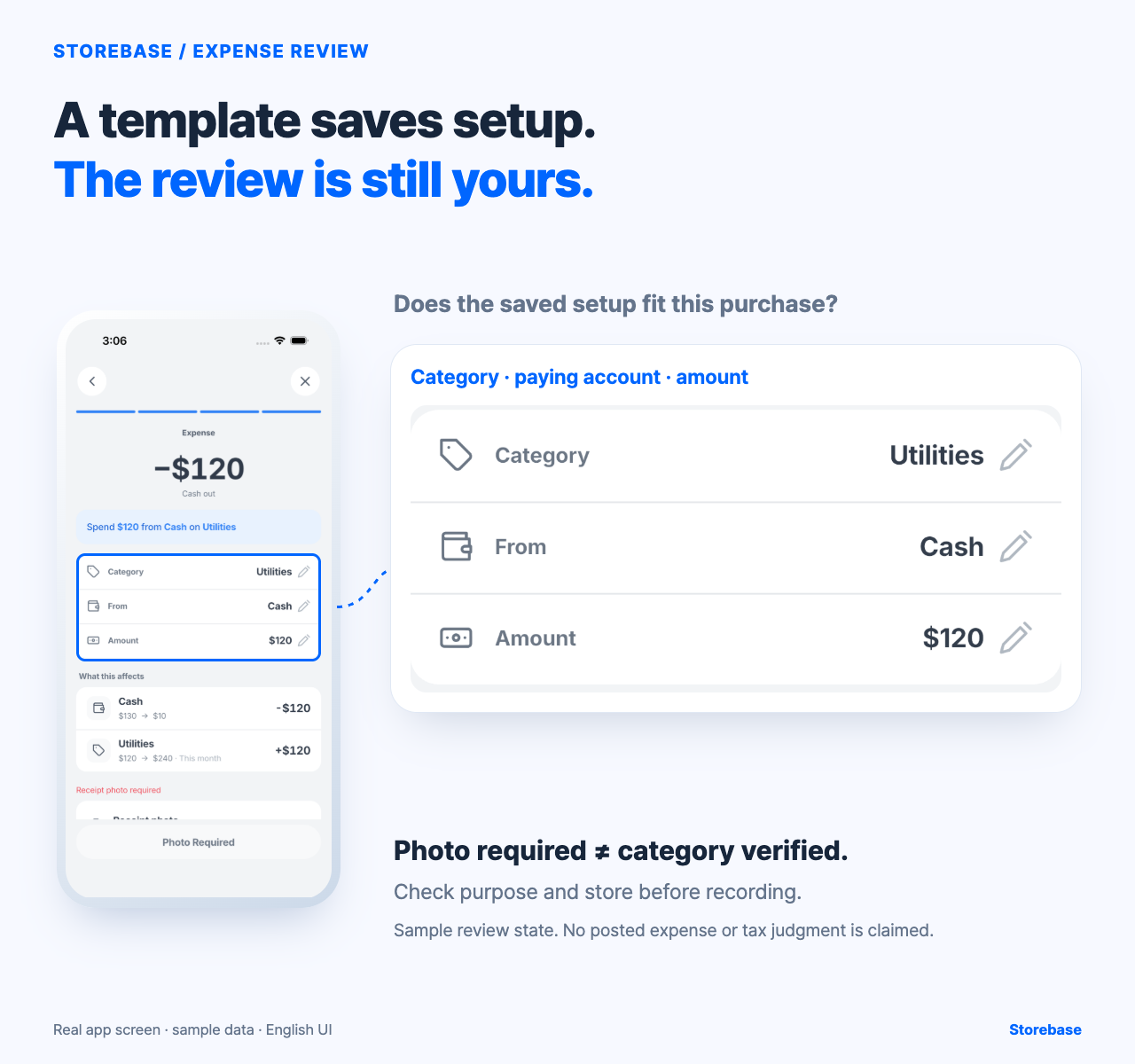
In Storebase’s expense template form, inspect the selected category (Utilities), paying account (Cash), amount ($120), and photo-required state before recording. This gives a small pilot a concrete check: do the template’s inputs match this transaction? The sample shows the form before recording, not a completed posting or a tax decision.
Include the work that remains
Include duplicate entry, external spreadsheets, training and migration when comparing costs. Record unsupported or unverified capabilities as open questions. Apply the same standard when evaluating Storebase.
The best choice is not necessarily the product with the longest feature list. It is the one your team can use to finish the necessary work while reducing the owner’s repeated checks.
Make the purchase decision falsifiable
Start with a decision statement that could honestly end in “do not adopt.” Name the locations and roles in scope, the single workflow being replaced, the current source of truth, the unacceptable failure modes, and the evidence required for approval. Separate three gates: the task can be completed correctly, the result can be reviewed under the intended permissions, and the team can repeat it without hidden vendor or owner intervention. A polished demonstration passes none of these gates unless the pilot participants perform the work themselves.
Build a traceability sheet from each essential requirement to one observed exercise. “Supports expenses” is too broad; a useful row says who prepares a specific expense, which evidence accompanies it, who may approve or correct it, where the final state is checked and what must be exportable or retained. Mark a requirement unsupported when it cannot be run. Do not replace it with a salesperson's explanation, roadmap statement, Core relationship or screenshot from another workflow. Distinguish a blocker from a preference so an attractive minor feature cannot offset a missing control.
Decide who may stop the pilot. A privacy breach, unauthorized role access, unexplained change to test data or inability to recover the baseline should pause the exercise immediately. Lesser failures become dated cases with an owner and retest condition. This protects the team from turning sunk setup effort into a reason to approve software that has not met the original decision.
Run the pilot in stages and preserve a clean exit
Begin with synthetic records designed to expose boundaries: an ordinary transaction, a wrong category, a missing attachment, a correction, a second role and a second store. Move to a small live slice only after access, privacy, backup and restoration responsibilities are understood. Minimize personal and customer information, define who can contact support, and keep the established operational path available during the bounded test. A pilot is not authorization for an irreversible full migration.
Capture evidence at each transition rather than at the final report alone. Record what the participant entered, what another role could see, the correction that was attempted, the state observed afterward and any help supplied outside the product. Time spent translating labels, preparing imports, rebuilding formulas, chasing support or maintaining a shadow file belongs to the evaluation. If the vendor performs a hidden cleanup, mark the result assisted and rerun the critical step with the actual team.
Before approval, rehearse the exit. Export or otherwise retrieve the agreed business records, confirm their meaning outside the trial, revoke test access and verify how sample or live data will be removed under the applicable agreement. Document unresolved dependencies such as proprietary identifiers, unavailable history or manual re-entry. The owner can then compare reversible operating value with ongoing cost, instead of confusing successful onboarding with durable control.
State exactly what the Storebase evidence proves
The captured Storebase example proves a pre-recording expense-template state containing a selected category, payment account, sample amount and a requirement for a photo. It supports one observable question in a pilot: can a participant inspect those inputs before choosing the next action? It does not prove that the record was submitted, saved, synchronized, approved, corrected, reported, restricted by role or attributed to the right store. The sample fields also do not validate business purpose, accounting treatment or tax consequences.
Source review adds only a partial engineering boundary. Template error reporting and validation code exists, but one validation provider is a mock; this does not establish runtime reachability or server persistence. Controlled evidence is still needed for saved-template reuse and for validation behavior to remain consistent with posted transactions. No current evidence certifies the complete cross-role workflow proposed by the article, migration from an existing system, offline recovery, audit history, service reliability or support response. An app-status label or Core relationship cannot fill those gaps.
Use these missing proofs as test cases, not negative claims about what the product can never do. Record observed results with the tested version, role, data and date. Storebase should advance only if the real team completes the required workflow within the stated boundaries and the remaining uncertainties are acceptable to the decision owner. That standard connects price to usable operating value without inventing a feature or a quantified saving.