
STOREBASE INSIGHTS · Sales and finance
When costs rise, separate quantity from price before blaming the month
Compare the same item, period and unit: total cost is quantity × unit price, with product mix shown separately. Use transaction records and receipts before deciding what changed. A record still does not decide accounting treatment.

On this page
“Costs rose” is not yet an explanation
A month-end total can hide two very different changes. You may have bought more units at the same price, paid more for the same quantity, or changed the mix of products. Each needs a different conversation. If the only answer is “it couldn’t be helped,” the team still does not know what to fix.
Start with a simple identity: total cost = quantity × unit price. Then show mix separately. The identity is a way to ask a precise question, not a promise that the source record is complete. Check the receipt, invoice, purchase order and the person who received or approved the item.
A small variance table
| Check | Record to compare | Question for the owner |
|---|---|---|
| Quantity | Units in the two comparable periods | Did demand, waste or stock policy change? |
| Unit price | Price per same unit | Did the supplier, contract or specification change? |
| Product mix | Items and proportions | Did a different, more expensive item replace the usual one? |
| Timing | Dates and period cutoff | Was a purchase pulled forward or recorded late? |
| Evidence | Receipt, invoice and approval | Can another person reproduce the comparison? |
Do not compare a case of goods with one bottle and call the price change mysterious. Normalize the unit first. Do not compare two months with different menus or campaigns without labeling the mix change. A clean table should make the next check smaller.
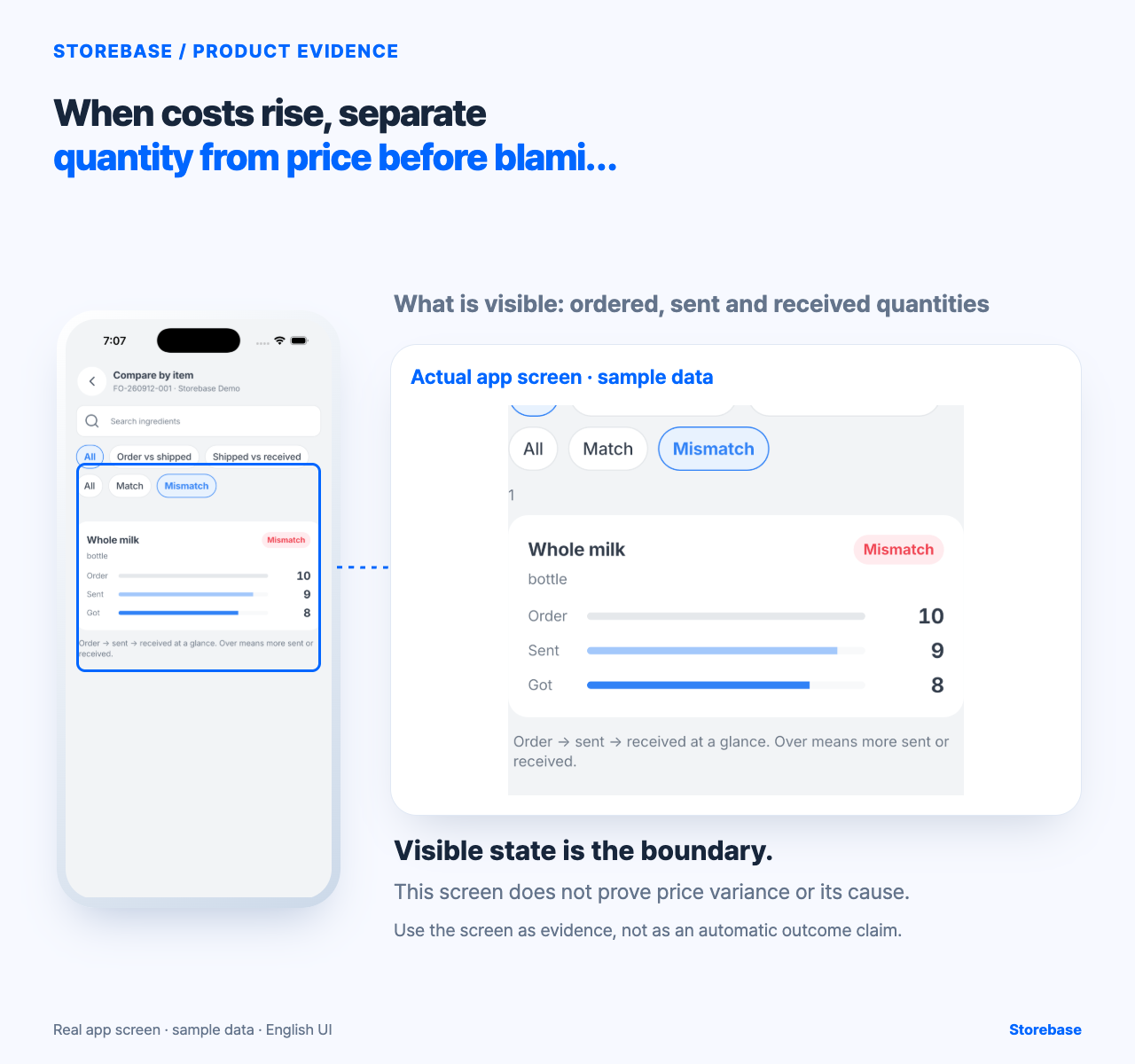
What Storebase can contribute
Storebase’s outflow and receipt-recording features can give the team a place to record the expense category, amount, memo and available receipt context, then return to the transaction when a variance needs explanation. That supports the first practical step: preserve a source-verified amount and its context before changing a category.
The available record does not show an automated model diagnosing quantity, price or mix from every receipt. Use the recorded transaction, source documents and a responsible reviewer to establish what changed. Ask an accountant about inventory costing, expense classification and tax treatment.
A weekly cost check
- Select one recurring item and define a comparable unit.
- Compare quantity, unit price and product mix for two periods.
- Attach or reference the receipt, invoice, order and approver.
- Mark whether the difference is quantity, price, mix, timing or unknown.
- Assign the unknown item instead of forcing it into a convenient explanation.
- Recheck the next purchase and keep the original record if a correction is needed.
What the result can tell you
If quantity rose, investigate demand, waste, portioning or purchasing policy. If unit price rose, review the supplier terms, specification and approval. If mix changed, decide whether the new item earned its place. If the source record is missing, the correct result is “not yet explained,” not a confident accusation.
The conditional benefit is a shorter cost conversation: a manager can ask which factor moved and who will check it. It is not a promised saving, automatic fraud detection or tax answer. After four weeks, ask someone who did not make the entry to reproduce one variance from the source record. If they can, keep the routine; if not, improve the moment of capture.
Build a cost bridge that reconciles to the observed change
The identity quantity × unit price is most useful when it becomes a bridge from the earlier total to the later one. Choose one consistent order of calculation. Using the earlier price as the quantity basis, calculate quantity effect = (later quantity − earlier quantity) × earlier unit price. Then calculate price effect = later quantity × (later unit price − earlier unit price). The two effects should add exactly to the total change for the same item, unit, currency and accounting cutoff. This is arithmetic allocation, not proof of the business cause.
If the bridge leaves a remainder, stop before explaining performance. Check package conversion, tax or delivery amounts included in price, returns, rebates, a changed item specification, a different currency basis, duplicate entries and late documents. For several items, build each item bridge first and show a separate mix line rather than forcing substitution into either quantity or price. Preserve the invoice and receiving evidence that defines each input; a fabricated or unsupported number can still make a perfectly balanced equation.
Storebase's recorded outflow and receipt context can help the reviewer return to the amount and source document already described in the article. The reviewed evidence does not show that Storebase calculates this bridge, normalizes units or decides the causal label. A manager verifies the operational reason, while the appropriate accounting reviewer decides cost treatment. Use a regression gate at the next purchase: another person must reproduce every bridge component from the same sources, and the components must reconcile to the ledger change. If the equation balances only after an undocumented override, the review remains open. Once this test holds, the owner receives a named factor and an unresolved remainder instead of a vague month-end explanation.