
STOREBASE INSIGHTS · Team management
Employee exit handoff: close open work, access and deadlines
Before an employee leaves, put every open task, current status, next owner, deadline and required access into one exit handoff. Close, transfer or explicitly escalate each item; test of the successor’s full competence belongs in a separate manager-handover process.

On this page
Start with what is still open
Do not begin with a biography of everything the employee knows. Ask what is incomplete or will next become due: an order awaiting delivery, a refund waiting for evidence, a cash difference under review, next week's schedule, an unresolved stock adjustment, a supplier promise or a report not yet submitted.
For each item, preserve the latest known state and the next action. “Supplier issue” is not enough. Record the supplier, reference, last contact, promised date, remaining question and who now owns the follow-up. A deadline without an owner will still return to the store owner.
The operating insight changes the diagnosis here: turnover becomes owner dependency when the departing person is also the only named owner of unfinished decisions and records. The exit itself is not something a checklist can solve. The preventable exposure is work whose owner, time and reasoning disappear together, forcing the store owner to reconstruct it after departure.
| Open item | Current status and evidence | Next owner | Deadline / trigger | Access or approval needed |
|---|---|---|---|---|
| Delivery not complete | order reference, quantity still due, last contact | manager | promised delivery date | supplier record and receiving authority |
| Refund under review | transaction, customer request, missing evidence | named staff member | response date | refund limit or manager approval |
| Cash or stock difference | count, original record, open question | reviewer | next count or close | relevant record access |
| Upcoming schedule or report | draft location and incomplete fields | manager | publish or submission time | roster or report permission |
Transfer access as a separate checklist
An open-work list and an access list answer different questions. For each account, device, key, shared folder or supplier channel, identify the business owner of the access, who needs it next and when the departing employee's access should end. Use the organization's approved process for changing or recovering access; do not copy passwords into the handoff table.
Record completion as an observable state: replacement access tested, departing access removed or an exception assigned to an authorized person. If removal cannot happen before departure, name the risk owner and the exact follow-up time instead of marking the item complete.
Hold a final deadline review
On the last working day, review only three groups: due before departure, due shortly after departure and blocked items. Close what is complete, assign what remains and escalate anything without an authorized owner. Keep the original status and the handoff decision together so the next person can see what changed.
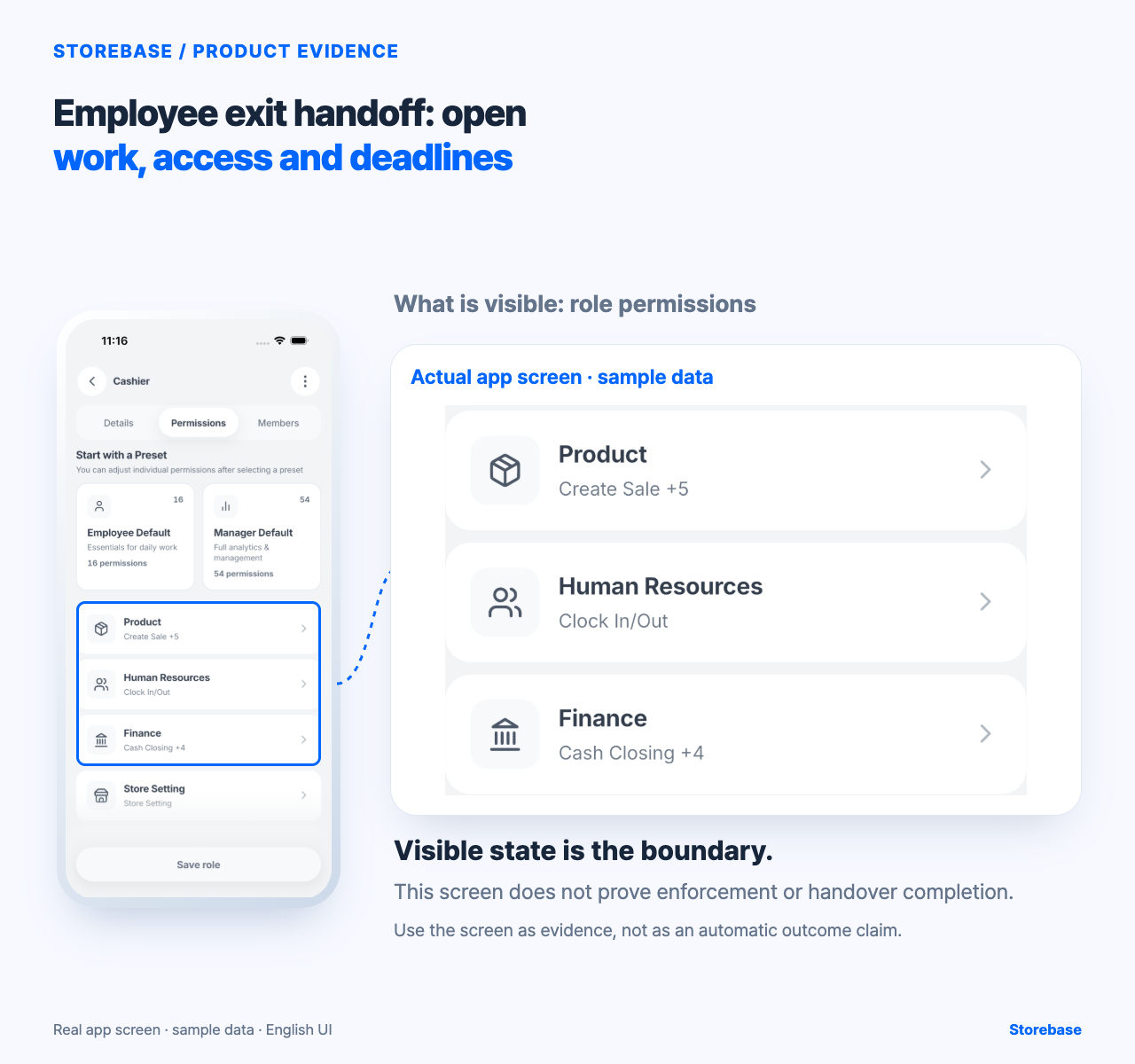
A shared operating record can support this process when it actually shows the task, date, responsible person or transaction involved. The available evidence does not establish a dedicated Storebase departure-handoff screen, automatic access transfer or replacement training. Use existing records only where they are verified in your own workspace, and keep the exit checklist under a manager's control.
Define completion by closed exposure
This exit handoff is complete when no open item lacks an owner or next date, required access has been transferred or explicitly escalated, and the departing employee's access has been handled under the store's policy. Whether a successor can independently perform the whole role belongs in the broader manager handover and training review.
The practical gain is smaller and more immediate: the owner does not discover an unpaid bill, unanswered customer or inaccessible account only after the former employee can no longer help. Review the handoff again after the nearest deadline and close the remaining exceptions.
Capture the decision rule, not just the last status
An open item can have an owner and deadline yet still fail after departure because the missing knowledge is conditional: when to reject a delivery, which discrepancy needs approval, which supplier promise overrides the standard lead time, or which customer remedy is within a manager's authority. Add four fields to high-consequence items: the trigger that requires action, the evidence the departing employee normally consults, the boundary beyond which the successor must escalate, and the observable result that means the work is closed. Also record abandoned approaches when repeating them would consume money, stock or customer trust.
This does not require turning every habit into a manual. Prioritize duties that will recur soon, involve an external commitment, move money or stock, or depend on access held by one person. Personal chat history and private employee material should not be copied wholesale into a business handoff. Extract the business decision and retain sensitive material only under the store's access and retention rules. A clean transfer leaves the successor enough context to act while revealing as little unrelated personal information as possible.
Storebase records may contribute only where the actual task, transaction, timestamp and role are already captured. Current evidence does not prove a durable knowledge repository, retrieval of prior decisions or automated training of a replacement. Treat the product record as one possible source in the handoff, not as evidence that tacit knowledge has been transferred.
Rehearse the next due task before access disappears
Choose the nearest recurring or externally committed duty and let the successor perform it in a controlled scope. The departing employee observes without taking over. Each interruption becomes evidence of a missing input, unclear authority or undocumented decision rule. Update the handoff with that exact gap, then repeat the relevant part until the successor can reach a reviewable result through the approved records and access. The exercise tests the handoff, not the person's worth or mastery of the whole role.
Run a second check at the first real deadline after departure. Compare what the handoff predicted with what actually happened: the source was findable, access worked, the decision stayed within authority, and the output reached the next person or system. If the task succeeds only because the owner supplies context by phone, record that dependency as an open exception. If the old employee's credentials are still required, stop the task and use the organization's recovery path rather than sharing the credential.
The owner benefit is a different decision point. Instead of discovering every missing dependency after it becomes urgent, the owner can choose before departure which gaps must be repaired, which may be accepted temporarily and which cannot be transferred safely. Expansion becomes less dependent on retaining one person's memory, while managers still own the judgment that no checklist can make for them.
Related resources
Explore Storebase team-management features
Store access permissions: separate viewing, entry and approval