
STOREBASE INSIGHTS · Team management
Fair employee scheduling: make shift decisions explainable
When employees say a schedule is unfair, do not start by making everyone's shift count identical. Check who was available, what each shift required, and whether the same rules were applied. Record allocation criteria and exceptions so decisions can be explained and corrected. Fair employee scheduling is an operating practice: apply clear criteria consistently, then review the opportunities those decisions create or remove.

On this page
- “They get shifts because they're friends” versus “They do the job well”
- What should you check before comparing shift counts?
- Can you explain one assignment without saying “they're better”?
- What if the old decisions were never recorded?
- What can scheduling software help with?
- Keep the owner responsible for rules and exceptions—not every shift
“They get shifts because they're friends” versus “They do the job well”
Imagine an owner delegating schedules across three stores. An employee says one person always gets the desirable shifts. The manager says that person is more capable. This scenario and the examples below are constructed illustrations, not a customer's dispute record.
If the owner settles it from memory or impressions, the same call can return with the next schedule. “Share shifts equally” may leave a required role uncovered. “Give them to the best people” leaves the meaning of “best” unexamined.
The schedule shows the decision, but may not show the criteria behind it. Before choosing whose account to believe, make the decision possible to check.
Storebase connects sales, inventory and team workflows for multi-location store owners. In scheduling, we value a process in which managers can review the information and explain their decisions, without the owner collecting every request and mediating every change.
What should you check before comparing shift counts?
Use the same period, location and genuine opportunities to work. Total shifts alone cannot tell you whether two people had the same opportunity to be assigned.
| Input | What to record | What becomes unclear without it |
|---|---|---|
| Availability | Dates, times and applicable week submitted by staff | Why someone was not considered |
| Role required | Specific requirement, such as independent closing | Whether “capable” means anything testable |
| Allocation criteria | Order used among eligible people | Whether the rule changes between decisions |
| Exceptions | Coverage change, reason and decision-maker | Whether a one-off exception became routine |
| Review | Repeated concentration by person and shift type | Whether the same pattern returns next week |
Availability is an input, not a promise of work. When I Work's guidance describes it as a preference an employer can consider when scheduling. Check your own agreed working arrangements and operating requirements as well. Understanding availability
Keep sensitive context private. The team may need to understand common allocation rules, but does not need another employee's personal reasons for leave or restrictions. Separate shared rules, explanations of an individual's own assignment, and manager-only information.
Can you explain one assignment without saying “they're better”?
Consider a hypothetical Saturday closing shift. Employees A and B are both available. The store needs one person able to close independently.
| Candidate | Confirmed condition | Decision this time | Next check |
|---|---|---|---|
| A | Can carry out the closing procedure independently | Assigned to close | Check whether desirable shifts repeatedly concentrate on A |
| B | Has not completed closing training | Not assigned to close alone yet | Name a trainer, training opportunity and review date |
“A meets this shift's closing requirement” is more testable than “A is better.” But it is not the end of the review. If B never receives training, the same criterion can keep excluding B indefinitely.
When capability is an allocation criterion, check access to the opportunity to develop that capability.
If B completes training, reassess under the same requirements. If A is still selected, check the reason and whether the agreed allocation order was followed. Different availability and coverage needs can produce different totals, so unequal counts alone do not establish unfair treatment.
What if the old decisions were never recorded?
Do not manufacture reasons for last month's assignments. Mark the supporting context as unknown and start with one store's next weekly schedule.
- The manager records the hours and roles that need covering.
- Staff submit availability by an agreed deadline and report changes.
- The manager applies the shared criteria and records exceptions.
- Before confirming, check open shifts and conflicts, and give staff a way to question their own assignment.
- At the next scheduling cycle, review repeated patterns in who receives or misses opportunities.
Start with rules that are simple enough to explain. Applicable working-time requirements and employment arrangements still need separate local review. This is an operating method, not a legal finding about fairness or employment advice.
What can scheduling software help with?
Storebase's public team-management guide describes collecting staff availability and reviewing it alongside the schedule, with managers checking coverage and constraints before confirming assignments. The contribution is a shared place to review the inputs instead of reconstructing them from separate conversations. Storebase team workflows
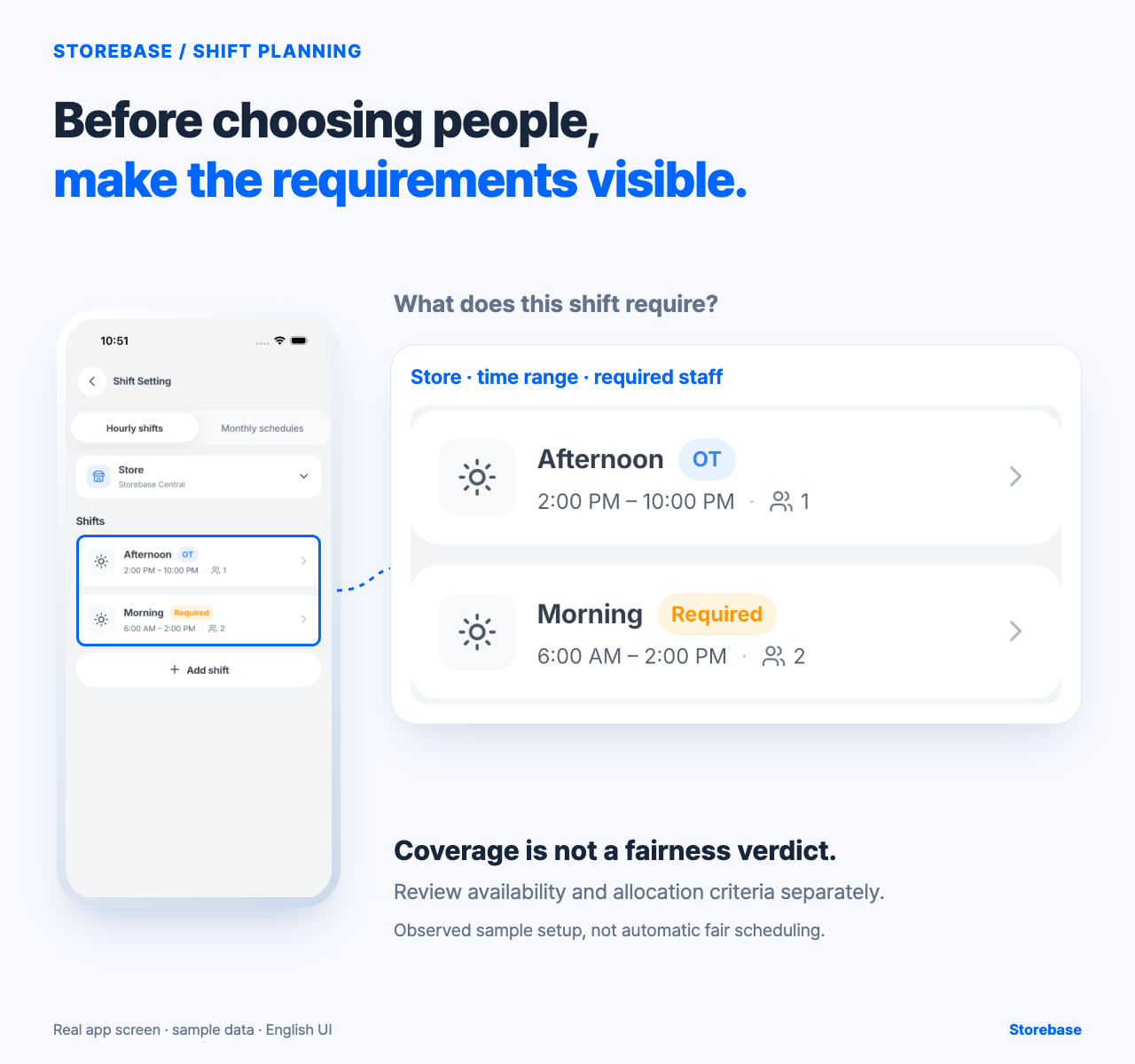
A shared schedule does not make decisions automatically fair. Choosing legitimate role requirements, checking bias, allowing an exception and providing training remain management responsibilities. Nor does this article claim that every field in its worksheet exists as a specific Storebase screen. Check permissions and the records your team needs before adopting the workflow.
When evaluating a tool, ask more than “Does it generate schedules?” Ask: “Can employees submit availability, and can the manager review the relevant information before confirming an assignment?” Explore Storebase availability and shift planning
Keep the owner responsible for rules and exceptions—not every shift
Let the local manager allocate and explain work within agreed criteria. Staff check their own availability, omissions and conflicts. Escalate changes to the criteria, repeated unresolved concerns and cross-store coordination that cannot be resolved locally.
Try one schedule with four things recorded: required role, allocation criteria, exception reason and next reviewer. Can the manager answer a question without asking the owner to reconstruct the decision? That is the first practical test.
The goal is not to silence questions. It is to make questions answerable through evidence and consistent criteria. As the team takes ownership of that process, the owner can step away from rewriting every store's schedule—and gain more freedom over time beyond the store.