
STOREBASE INSIGHTS · Sales and finance
Profit is not the cash available for the next debt payment
To judge whether the store can meet its next debt payment, calculate usable cash through the due date: current unrestricted cash plus supported receipts, minus committed operating outflows and a chosen buffer. Compare that amount with debt service; accounting profit remains a separate performance measure.

On this page
Name the decision and the date
Write down the next payment date and amount from the lender's current statement or schedule. Then set the review window from today to that date. The question is not “Was this month profitable?” It is “After the obligations due in this window, how much usable cash remains for this payment and a stated operating buffer?”
The operating insight is more specific than “net profit matters more than revenue.” That advice still hides the owner’s immediate decision. Two periods with similar accounting profit can leave different cash available because receipts, payroll, supplier commitments and debt dates occur at different times. The missing visibility is not another profit label; it is a due-date view of what cash is already spoken for.
Do not treat the full bank balance as available. Some of it may already be committed to payroll, suppliers, rent, tax or customer refunds. Do not treat every expected sale as cash either; include a receipt only when its timing and collectability are reasonable for this decision.
| Cash-availability input | Include for the due-date view | Keep separate |
|---|---|---|
| Usable cash now | unrestricted balances in the chosen accounts | restricted or disputed funds |
| Receipts before due date | expected deposits with a stated timing basis | sales unlikely to settle in the window |
| Operating commitments | payroll, suppliers, rent, refunds and other scheduled outflows, excluding the targeted debt payment | costs outside the review window |
| Debt service | payment due in the window, using the lender's current amount | accounting classification of principal, interest and fees |
| Operating buffer | an amount the owner explicitly chooses not to spend | profit or an assumed future sale |
A practical working calculation is: usable cash now + supported receipts before the due date − committed outflows − chosen operating buffer. The targeted debt payment is deliberately not included in committed operating outflows, so it is not subtracted twice. Compare the calculated cash available with that payment due. This is a planning view, not a bank guarantee, liquidity audit or accounting statement. If the result is short, the next action is to verify timing and amounts, then speak with the relevant lender or qualified adviser where needed—not to rename revenue as available cash.
Use the profit report for the question it can answer
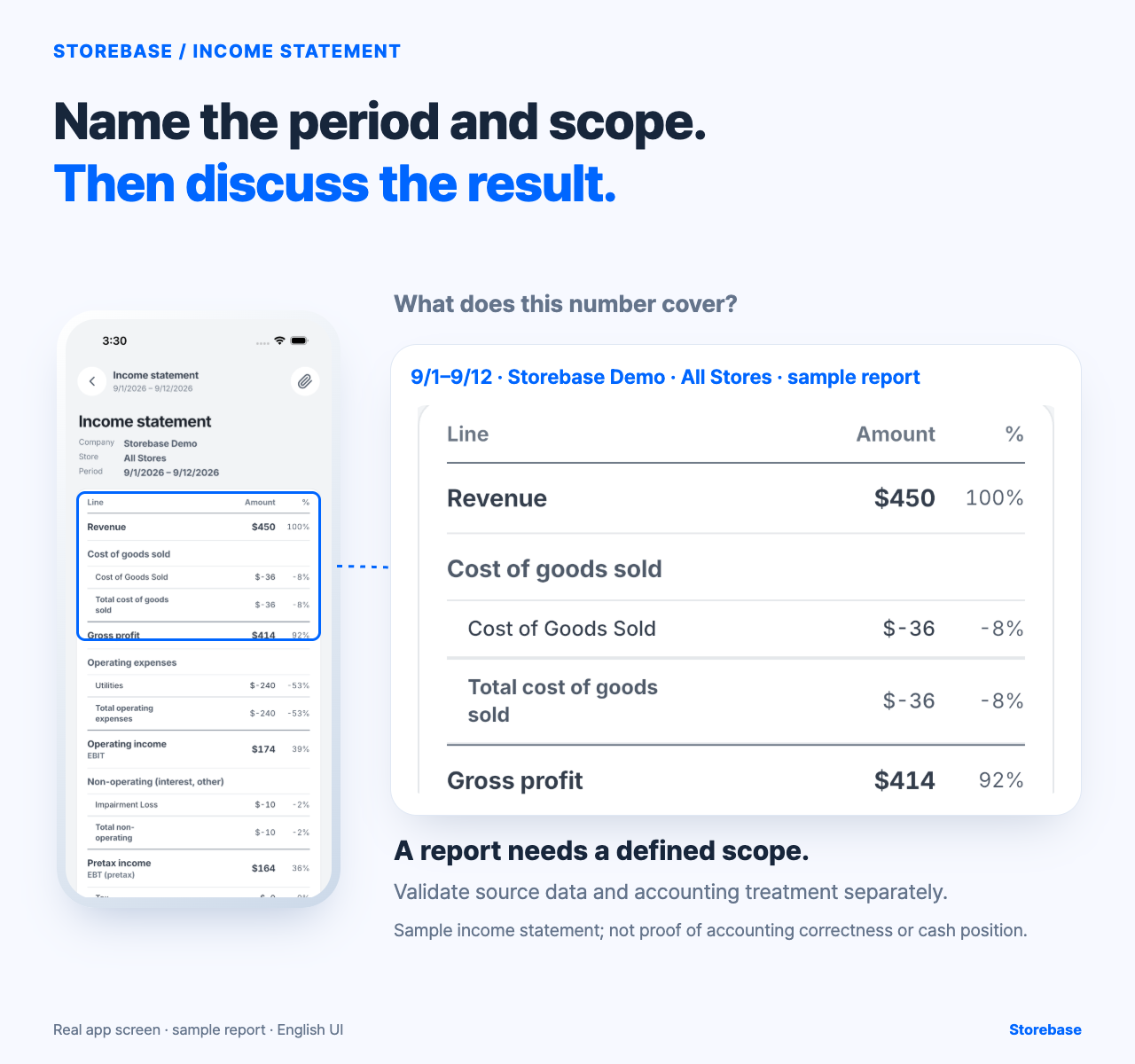
The Storebase income-statement view can organize recorded revenue, cost and profit rows for a selected period and scope. Use it to understand whether operations generated accounting profit under the recorded inputs and to identify costs that need explanation. The reused product image does not show owner pay, loan principal, cash availability or a debt-service forecast.
The report is therefore an input to the review, not the answer to the due-date question. Confirm the bank balances, payment schedule, expected receipt timing and committed outflows separately. The available evidence does not prove automatic POS ingestion, current cost bases, automatic principal-interest classification or tax treatment.
Review the gap before the due date
- Confirm the payment date and current amount from the lender's record.
- Freeze the accounts and window included in this review.
- List usable cash and only the receipts expected inside the window.
- List payroll, supplier, rent, refund and other commitments due first.
- Preserve the chosen operating buffer instead of spending the last available unit of cash.
- Compare the remainder with the debt payment and assign every uncertain item an owner and check date.
Repeat the view when a material receipt or obligation changes. A positive accounting profit can coexist with a near-term cash shortage, while cash on hand can coexist with weak profitability. Keeping those facts separate helps the owner decide earlier whether to collect, delay a discretionary outflow, correct a record or seek qualified help.
This article does not determine accounting, tax, lending or legal treatment. Record what was confirmed, what remains an estimate and who will check it. The goal is a defensible view of cash available for the next debt-service date—not another generic reading of sales versus profit.
Turn the forecast miss into the next operating decision
The due-date calculation becomes useful only when the team can explain why reality moved away from the prior view. At each refresh, preserve the earlier snapshot and make a short bridge to the new result: a receipt arrived later than its supported date, a supplier obligation was omitted, the lender amount changed, restricted money was mistakenly included, or the chosen buffer was revised by the owner. Name the evidence, the person responsible for checking it and the date by which the uncertainty must be resolved. Do not rewrite the old view as though the new fact had always been known.
Give the store manager authority over only the responses that are already within policy, such as chasing a documented receivable or postponing a discretionary purchase. Renegotiating debt, moving restricted funds, missing payroll or changing an accounting classification belongs with the appropriate owner, lender or qualified professional. After the payment date, compare the planned receipts and outflows with what actually cleared, then use the unexplained differences to improve the next window's input rules. Success is not a forecast that never changes; it is a change whose cause and consequence can be traced before the obligation becomes an emergency.
Storebase can contribute a selected-period, selected-scope view of recorded revenue, cost and profit. Reviewed source supports those scope controls, but does not prove instant refresh, complete cash coverage, runtime totals or agreement with every source system. Keep the debt-date bridge as a controlled management record. When routine variances have a responsible manager and only authority-crossing choices reach the owner, the owner spends attention on an actual decision rather than assembling the same cash story again.
Related resources
Explore Storebase financial reports and record-keeping
Taking money out of a store: distinguish expenses from owner withdrawals