
STOREBASE INSIGHTS · Multi-location operations
Watching store CCTV all day? Define the event you need to check
Watching CCTV across several stores is not the same as resolving operational problems. First narrow the location, time and event, then review the relevant footage. Video can support an investigation; it does not replace transaction and operating records.

On this page
Watching is not diagnosing
A quiet scene does not prove that no sales occurred. A busy counter does not identify the transaction behind a discrepancy. Without an event reference, reviewing footage from the beginning simply creates another task for the owner.
Attach three things to a review request
- Identify the store, time window and specific incident.
- Link the transaction, closing discrepancy or other record already checked.
- State the question that the footage might answer.
For a cash discrepancy, start with refunds, voids and cash movements in the relevant period instead of watching employees indiscriminately. Use footage to address the remaining question. A scene alone should not be treated as proof of intent or responsibility.
Close the investigation, not just the video
The reviewer should record confirmed facts, unresolved questions, actions and the result of a follow-up check. Emergencies need their own immediate response process. Manage video access and retention according to applicable privacy requirements.
When evaluating operating tools, look beyond video integration: can staff find the store, time and transaction context? The goal is a team that can narrow and resolve ordinary incidents, escalating only what needs the owner’s decision.
Create the incident envelope before anyone requests footage
Continuous viewing usually begins because the organization has no agreed trigger for an investigation. Replace the open-ended instruction to “check the camera” with an incident envelope created from a non-video record: a closing difference, a customer complaint, a safety report, an access event or another documented exception. The envelope should contain the store, bounded time window, transaction or task reference, the single factual question, the requester, the authorized reviewer and the deadline. It should also state what would count as enough evidence to close the question.
The reviewer checks the operating record first and opens footage only if the remaining question can reasonably be answered by a limited segment. Record what the scene confirms, what it cannot establish and which action follows. Images may show that a person or object was present; they do not by themselves settle intention, policy compliance, identity or responsibility. If the available record already resolves the issue, do not access video merely to make the file feel complete. If the scene introduces a different concern, open a separately scoped case instead of letting the original review expand without limit.
Give managers authority to close ordinary, low-consequence incidents only when the store has already defined the evidence and remedy. Safety threats, suspected crime, employment discipline, disputed identity and material loss need the appropriate escalation route. This changes the owner's role from default observer to decision maker for exceptions that exceed local authority. It does not promise that every incident can be solved remotely or that video removes the need for people on site.
Test the operating method without claiming a camera feature
Run a bounded pilot with previously closed incidents from one location. Remove the prior conclusion, give the manager the transaction or operating records first, and require a written question before any clip is viewed. Compare the new disposition with the authorized historic outcome and note whether the manager found the right time window, avoided unrelated footage, separated observation from inference and produced a checkable closure record. Include at least one case that does not require video and one that remains unresolved after viewing. The method fails if the owner still has to locate every event, interpret every scene or supply the final reason by phone.
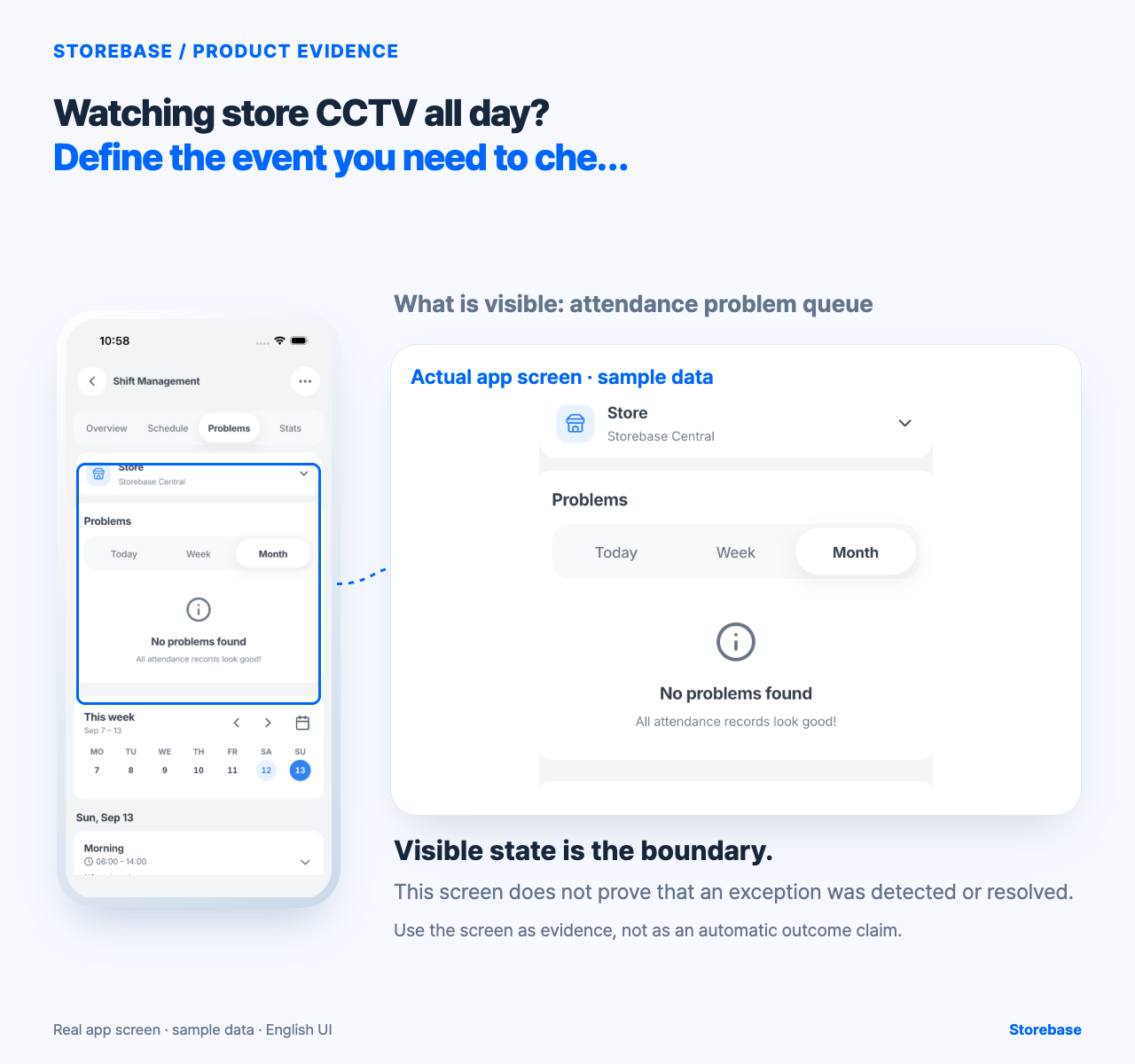
There is an explicit product-evidence gap here. The cited Core problem names operating and delegation capabilities, but this article's provenance contains no feature identifier, screen evidence or runtime result establishing CCTV integration. Nothing currently reviewed proves camera connection, automatic event detection, clip retrieval, identity recognition, video alerts or a completed remote-investigation workflow. Absence of mapped evidence is not proof that such capability does not exist; it is a boundary on what this article may claim. Storebase should therefore be described only through operating records that are independently verified in the actual workspace, not as a surveillance product.
Apply a privacy and legal gate before the pilot. Establish a lawful purpose and local basis, give required notice, restrict access by role, minimize the viewed area and duration, protect exports, define retention and deletion, and document who accessed material and why. Avoid collecting audio, biometric inference or unrelated employee and customer activity unless the applicable rules and necessity have been confirmed. Requirements differ across jurisdictions and workplaces, so obtain qualified local advice for employment, data-protection and law-enforcement questions. A faster review never justifies indiscriminate monitoring. The desirable result is fewer unnecessary views and a defensible path from a recorded exception to a bounded decision.
Audit the viewing decision after the case is closed
Select a closed case and inspect the access trail independently of the incident conclusion. The reviewer should be able to explain why each viewing was necessary, whether the person had the correct role, which bounded interval was opened, whether any copy left the protected system and when that copy must be removed. A justified outcome does not cure excessive access, and perfect access paperwork does not make a weak allegation true. Evaluate the investigation decision and the handling of personal data as two separate controls.
Then test the retention endpoint. Confirm that material due for deletion is removed through the approved process while the non-video closure record retains only what is needed to explain the operational decision. If legal preservation is required, document its authority, scope and release condition rather than extending every file indefinitely. Revoke access when roles change and investigate unexplained viewing as its own event. This post-case audit shows whether reduced owner watching has been achieved by disciplined delegation, rather than by moving unrestricted surveillance to another employee.