
STOREBASE INSIGHTS · Multi-location operations
Store incident reports: send the information needed for a decision
A remote store incident report should support a decision, not merely describe concern. Send the location, time, confirmed facts, actions already taken and the decision required together. “What should we do?” alone makes the owner collect the context again.

On this page
The recipient was not there
A photo may omit what happened before or after it. A long chat may hide the latest state. Separate confirmed facts from interpretation before asking another person to decide.
Keep one record per incident
- Distinguish when the event occurred from when it was discovered.
- List what is confirmed and what remains unknown.
- Record attempted actions and their results.
- Name the decision needed, its owner and its deadline.
Attach subsequent replies to the same record so a replacement manager can find the current state. Emergencies require the agreed immediate response; completing documentation must not delay it.
Finish with the outcome
Do not close the incident merely because a decision was made. Confirm that the action happened and record the result. When evaluating multi-location tools, test continuity of the evidence and actions rather than notification volume.
Good reporting is not a faster way to summon the owner. It lets staff finish what they can locally and escalate only the decision they cannot make.
Route the incident by consequence and decision authority
A complete description can still reach the wrong person. Define routing before the next event by pairing observable conditions with the decision role. Immediate threats to people or premises follow the emergency path first. A routine customer remedy, a reversible stock correction or a maintenance workaround may sit within a manager's written authority. Suspected crime, employment discipline, large financial exposure, regulatory reporting or an action that cannot be reversed belongs with the designated specialist or owner. Use local policy and qualified advice where legal duties apply.
The handoff should ask for one decision, not transfer the whole anxiety. State the proposed action, alternatives already considered, the latest safe decision time and what happens if nobody responds. If the local team has a pre-approved containment step, record when it began and what condition ends it. Do not disguise a permanent operational change as temporary containment. The recipient can then approve, reject, request one missing fact or redirect the case without rereading an unbounded chat.
Separate notification time from decision time and action time. A fast alert is not useful if the evidence arrives later, and an early decision is not closure if nobody performs it. Keep these moments distinct so the team can see whether delay came from detection, context collection, authority or execution. The owner should receive cases because the consequence crosses a boundary, not because every employee knows only the owner's phone number.
Preserve evidence without freezing the first story
An incident record must be correctable. Retain the original observation, then append later evidence with its source, time and author. If an earlier statement proves wrong, mark the correction and explain its effect on the requested decision; do not rewrite the record so it appears that the team knew the final story from the beginning. Photos, messages, receipts or device logs need a clear relationship to the event and should be collected only within applicable access, privacy and retention rules.
Use a status vocabulary that separates work rather than emotion: contained, awaiting evidence, awaiting decision, action in progress, ready for outcome check or closed. Each transition needs a responsible role and a next deadline. “Urgent,” “bad” or “handled” cannot replace those facts. When several stores report related symptoms, keep their local records intact and link them to a coordinating case; merging everything into one narrative can erase which store took which action.
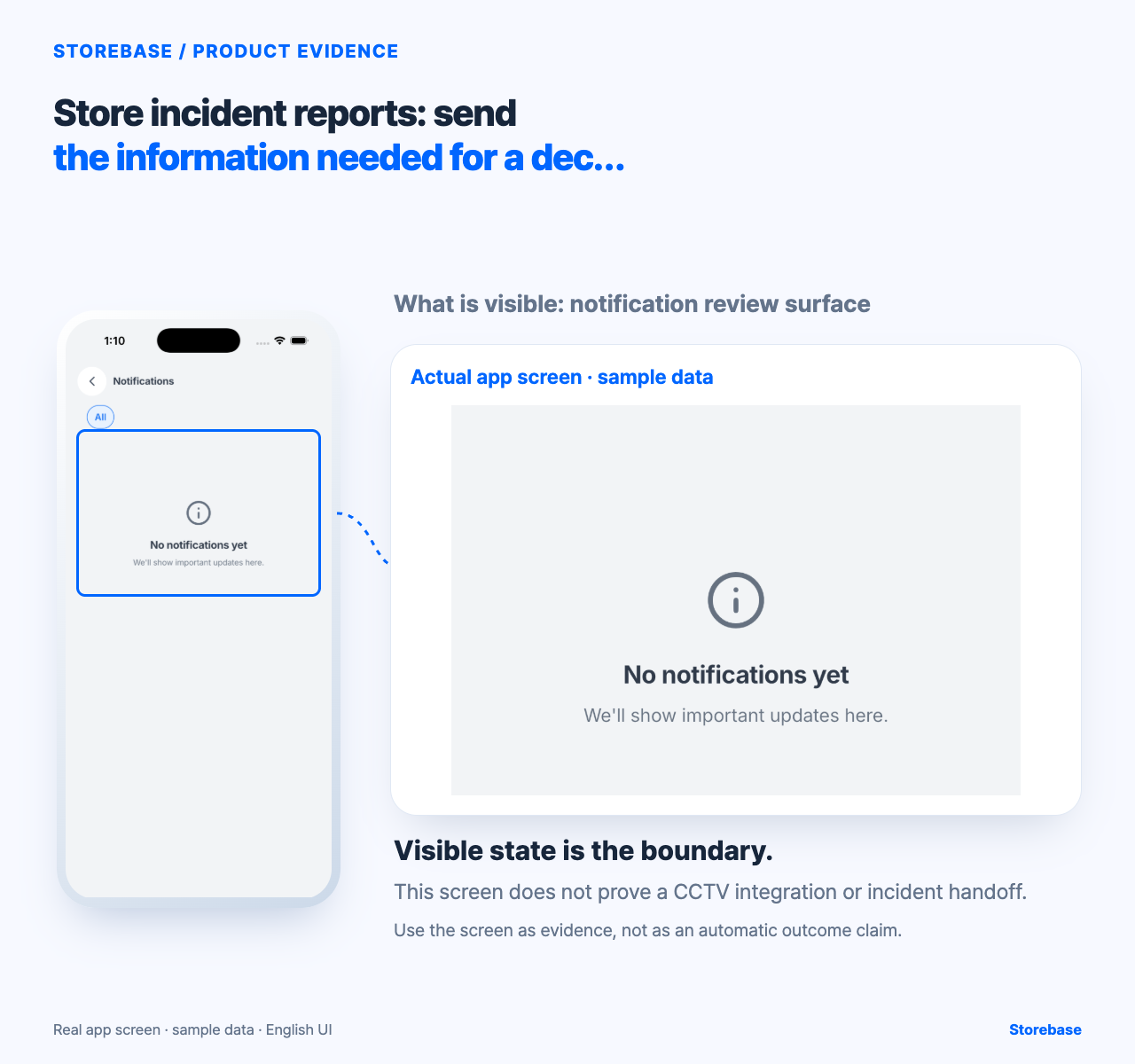
This article has no linked product feature, mapped screen or runtime result proving an incident case, notification router, correction history, role enforcement or cross-store linkage in Storebase. Those capabilities may be criteria in an evaluation, but they cannot be presented here as implemented behavior. Use the workflow as an operating design until each product step is observed with appropriate test data and access.
Rehearse a handoff while the incident is no longer dangerous
Choose several closed events with different consequences and remove their final decisions from the exercise copy. Let a staff member prepare the handoff and the intended recipient respond using only the permitted record. Observe whether the report reaches the correct role, exposes the single decision, preserves unknowns, triggers the right containment and produces an outcome check. Include a harmless false alarm and a case that must bypass routine documentation for emergency action. The drill is not a performance trap; every interruption identifies a missing field, policy or access path.
Include the intended recipient's absence in one rehearsal. The routing plan should identify an authorized substitute, preserve the same decision limit and prevent two people from issuing incompatible instructions. When the original recipient returns, that person should be able to see who acted, under which authority and whether further review is still required. A fallback that simply sends everything to the owner has not solved the handoff.
After the drill, compare the reconstructed decision with the authorized historical result. A different answer is not automatically failure, but it must be explainable by changed policy, new evidence or an ambiguity now exposed. Update the routing rule or handoff requirement, then rerun only the failed transition. Pass when another shift can reach a defensible action without an off-record call to the owner and when the final result returns to the original case.
Repeat a smaller check after a manager or policy changes. If cases begin stopping at the former role, losing their next deadline or closing before outcome confirmation, the handoff has regressed. This gate makes time back credible: ordinary events complete through defined authority, while the owner is interrupted for the few decisions only the owner can make.
Related resources
See how Storebase connects multi-location work
Cash closing exceptions: when should the owner be involved?
Watching store CCTV all day? Define the event you need to check