
STOREBASE INSIGHTS · Team management
Employee clock-in rules: separate the timestamp from the decision
For multi-location stores, separate the clock-in timestamp from the decision about lateness. An owner and an employee may interpret “nine o’clock” differently even when they agree about the recorded time. Preserve the original event and define which rule applies before using it to evaluate attendance.

On this page
A more accurate clock does not settle the rule
A timestamp of 09:00:46 describes an event. Whether it meets the agreed start-time standard is a separate decision. Replacing it with 09:00 destroys the distinction between a recording error and a policy disagreement. Different managers can otherwise reach different conclusions about the same event.
Keep three separate records
| Layer | Record |
|---|---|
| Schedule | Store, work date and planned start |
| Event | Actual timestamp and recording method |
| Decision | Rule version, exception and reviewer |
Give employees a way to inspect and challenge a recording error. A device failure, an approved schedule change and an unexplained late arrival should not share one correction reason. A manager should document a correction without erasing the original event.
Test consistency, not just clock accuracy
During the next scheduling cycle, ask two managers to apply the standard to the same example. When evaluating attendance software, test original records, schedule changes and correction reasons together. An attendance classification does not itself determine lawful pay treatment; review contracts and applicable requirements separately.
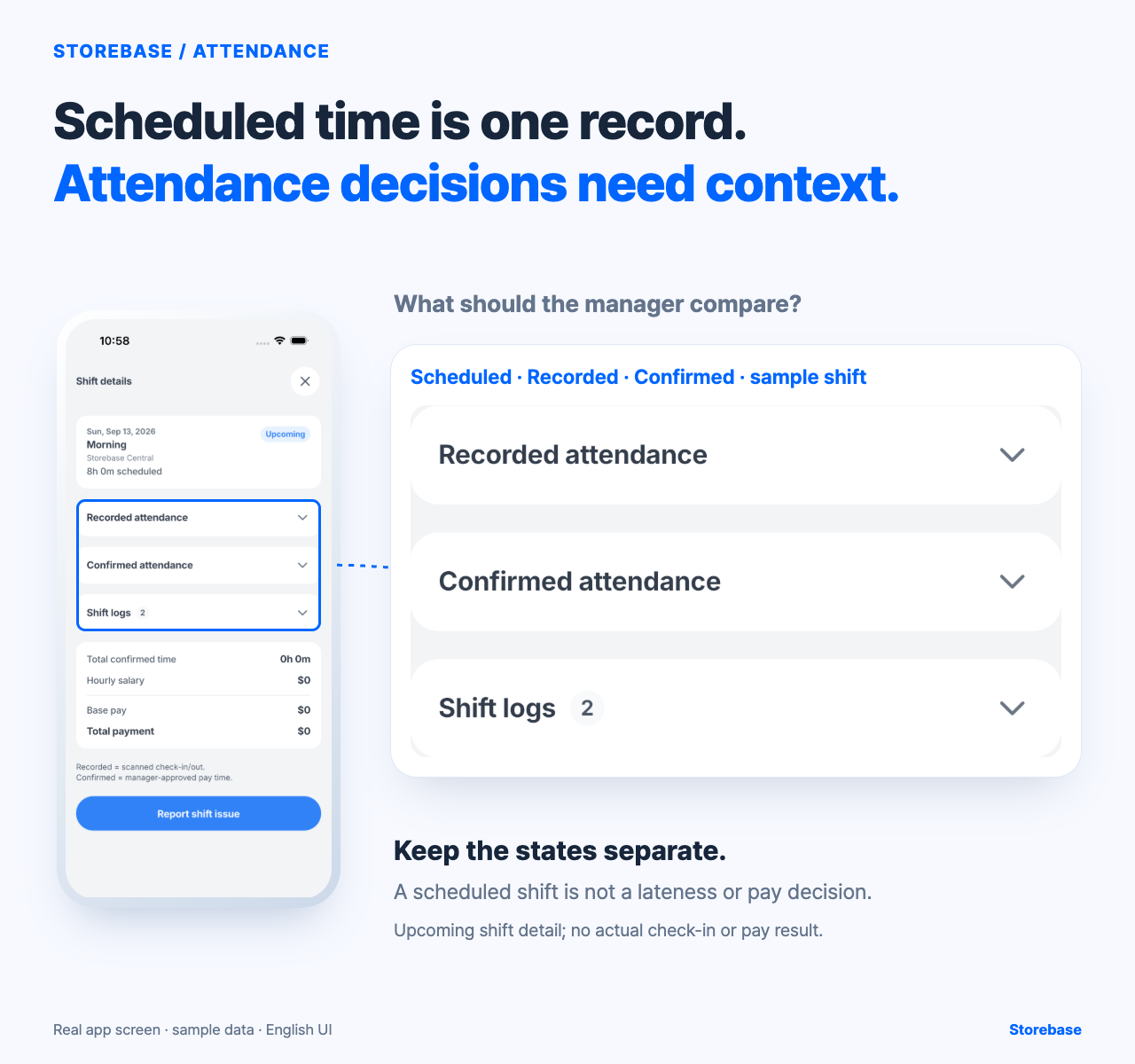
Storebase’s Shift details view keeps the scheduled shift, recorded attendance, confirmed attendance, and shift logs as separate sections. Use it to give the manager and employee the same starting point and to inspect the report path when a timestamp is disputed; it does not decide whether 9:00:46 is late or calculate lawful pay.
The aim is not to make the owner adjudicate every minute. Employees need a predictable standard, and managers need enough context to handle ordinary cases without another call.
Write the boundary before the next edge case arrives
A start-time rule needs more than a scheduled hour. Define what must be true at the boundary: which clock is authoritative, whether the employee must be inside the store or ready at the assigned station, how an inclusive cutoff is read, and which approved schedule changes replace the original plan. If the business uses a grace period, state whether it changes the attendance classification, pay calculation, or only the manager’s follow-up. Those are different consequences and should not be hidden inside one label.
Add an effective date and a rule owner. Events before that date remain under the earlier standard; changing the policy should not rewrite history. Name the evidence accepted for a device failure or approved change, the route for an employee to challenge an incorrect event, and the role allowed to confirm the result. The objective is not a stricter clock. It is a rule whose meaning stays stable when the location, manager, or employee changes.
Use examples at both sides of the boundary before rollout: one event just before the cutoff, one exactly at it, one just after it, an approved schedule change, and a failed device. Ask the team to classify each example and explain which field determined the answer. If the explanations differ, the policy is still relying on private interpretation.
Communication is part of the control. Give affected employees the version, effective date, examples, and challenge route before the rule is used. Record acknowledgement separately from agreement: a signature can show receipt, but it does not prove the rule is lawful, understood, or correctly applied. Ask one employee to describe the boundary in their own words; unclear retelling is a reason to revise the explanation before evaluating anyone.
Run a shadow test before the rule affects pay or discipline
For one scheduling cycle, keep the proposed classification beside the existing process without changing wages or issuing discipline from the trial alone. Preserve each original timestamp. Have two managers independently classify the same small set, then compare where their answers diverge. The disagreement categories matter: ambiguous cutoff wording, an unrecorded shift change, missing device evidence, or different views of what “ready to work” means require different fixes.
Record the trial in four columns: source event, schedule version, proposed decision with reason, and reviewer. Add a fifth field only when an exception is claimed: the evidence that supports it. Do not average the two managers’ answers or replace the raw event with the preferred decision. Resolve the policy ambiguity first, publish the clarified version with a new effective date, and repeat only the examples that failed.
The pass condition is not perfect agreement because a manager was coached in the room. A second location should reach the same answer from the written rule and preserved records without calling the person who drafted it. If consistency disappears when that person steps away, the owner has documented a preference, not established an operating standard.
Keep correction, exception approval, and rule change distinct
Correct a timestamp only when evidence shows the recorded event itself is wrong. Approve an exception when the event is accurate but a documented circumstance changes how the current rule applies. Change the rule when repeated disputes reveal that the shared standard is incomplete. These actions have different owners and should leave different histories.
The available Storebase Shift details evidence can help reviewers look at scheduled, recorded, confirmed, and logged information as separate areas. It does not supply the store’s cutoff, decide whether an exception is justified, determine lawful wages, or prove that every edit persists with the required audit history. Test those behaviours and permissions in the actual workspace before making them part of policy. Employment terms, pay treatment, and record-retention duties require review against the rules that apply where the store operates.
After the first month, sample disputed and undisputed events from each location. Check whether the original event remains visible, the correct rule version can be identified, the reviewer’s reason is present, and older events were not reclassified by a later policy. A failure on any of these points is a regression even if the monthly lateness total looks tidy.
Related resources
Explore Storebase team-management features
How to keep a late-arrival explanation with the attendance event