
STOREBASE INSIGHTS · Sales and finance
When cash moves from the till to the bank, leave a handoff record
Record the date, person, source till, destination account, expected amount and counted amount when cash changes hands. A structured movement record helps the next person locate a discrepancy; it does not replace a physical count, deposit receipt or bank reconciliation.

On this page
The gap between the till and the bank
Cash custody changes in a few seconds: a shift closes, someone counts the till, a deposit bag leaves the store, and the bank later reports a credit. When those steps are recorded in different places, the owner is left with one question: who moved what, and when? A night deposit or smart safe may change the physical process, but it does not by itself explain the record.
The useful habit is to treat the handoff as a small transaction with an owner. Write down the expected amount before the move, the amount actually counted, the source and destination, and the person responsible for the next check. The record should make a later question narrower, not make the difference disappear.
Use the same fields every time
| Handoff field | What to write | What still needs checking |
|---|---|---|
| Date and time | When the count and transfer happened | Compare with shift close and bank posting |
| Source | Till, register or store account | Confirm the physical source |
| Destination | Deposit account or bank drop | Check the deposit receipt and bank credit |
| Expected amount | The amount the records say should move | Confirm the calculation and included items |
| Counted amount | What the person actually counted | Recount when the difference matters |
| Owner | Who counted, sealed, carried or received it | Confirm the next custody step |
A difference is information. Do not silently change the expected amount to match the counted amount. Keep the two numbers visible, note the reason if known, and assign the follow-up. A short note such as “register close, deposit bag, counted by shift lead” is more useful than a vague “cash moved.”
Where Storebase can help
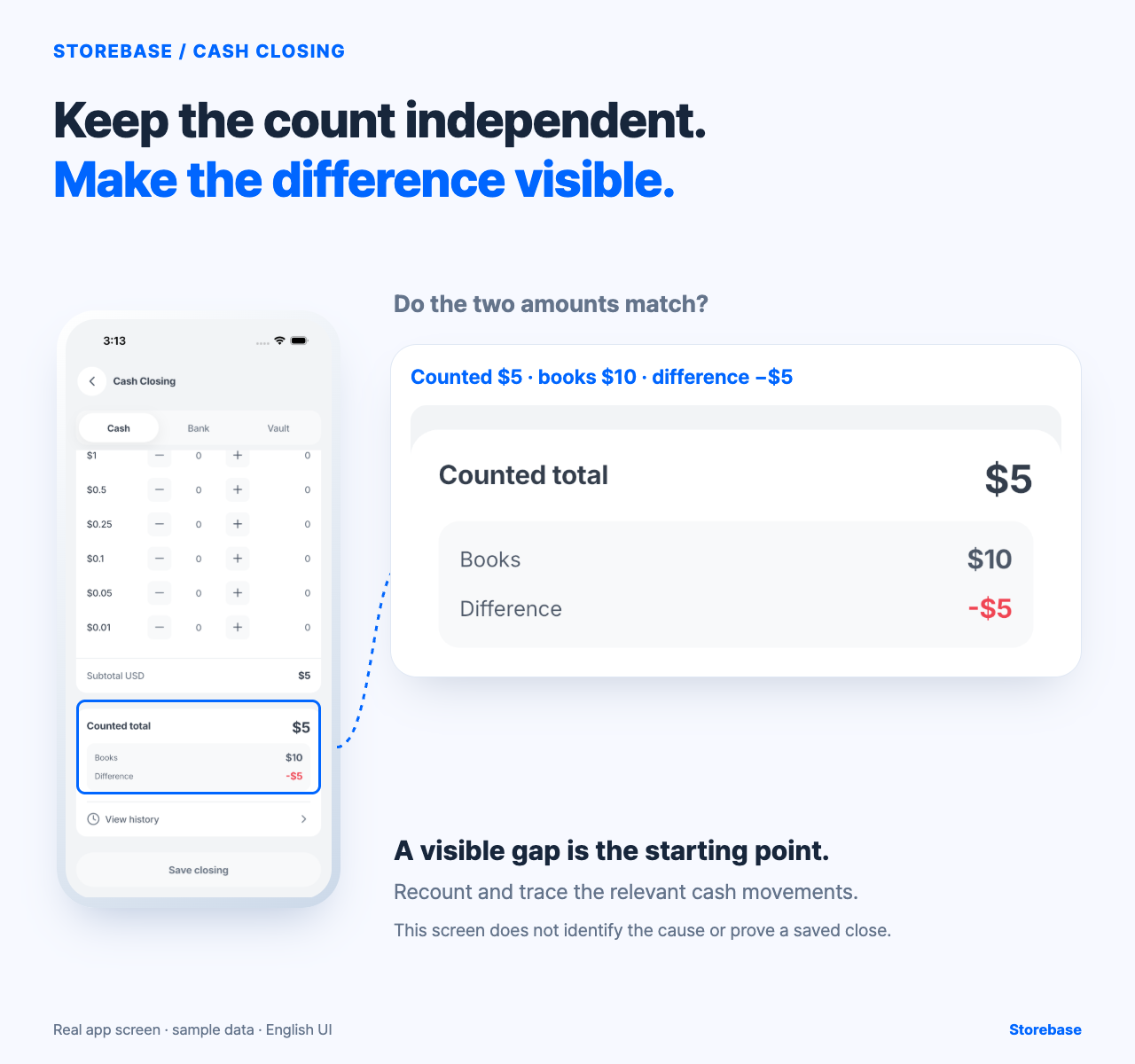
Storebase’s cash-management view can place expected cash beside the amount actually counted for a closing review. That gives a manager a starting record for the open difference before checking a till-to-bank handoff against its physical and bank evidence.
Use that record to locate the handoff and the open difference. It does not mean Storebase controls a smart safe, confirms a bank deposit, or automatically maps every exception. The person responsible still counts the cash, keeps the deposit evidence, checks the destination account, and resolves any mismatch.
A handoff routine for the end of a shift
- Close the register and record the expected cash for the agreed period.
- Count the cash with a second person when your policy requires it.
- Enter the movement with source, destination, amount and responsible person.
- Record the physical counted amount separately from the expected amount.
- Seal or transfer the deposit according to your local procedure and retain the receipt.
- At the next review, compare the deposit evidence with the bank credit and leave unresolved differences assigned.
The benefit is a shorter investigation
A handoff record cannot tell you whether a bank credit is correct or why a count differs. It can tell the next reviewer which movement to open, which amount was expected, who handled it and which evidence is still missing. That reduces the need to ask every person to retell the same shift.
Try the routine for one week and count unresolved handoffs at the review. If a second person can find the source, destination, expected amount, counted amount and owner without rebuilding the shift, keep the routine. If not, repair the counting or deposit procedure before adding another report. For accounting, tax, employment or cash-control policy, confirm the treatment with qualified local guidance.
Record release and acceptance as two custody events
Writing one person’s name beside “deposit” leaves a blind interval. The releaser should record the counted amount, bag or seal reference, source location, time, and condition at handoff. The receiver should independently acknowledge the same reference, time received, visible seal condition, destination, and any immediate difference. If the cash passes through a safe, courier, or second manager, each change of custody needs its own release and acceptance rather than one final owner.
A unique bag or seal reference connects the physical object to the record without claiming that the seal prevents loss. Do not reuse the same reference for a second trip, and do not silently replace it when a bag is repacked. Link the old and new references with the reason and both people present. For an unattended bank drop, the deposit receipt or machine record becomes the next acknowledgement; until that evidence exists, the movement remains in transit.
Define the exceptions before the first trial. A broken or mismatched seal, missing acceptance, unexplained change in amount, destination change, or transit beyond the expected window should remain open and move to the role authorized by the cash policy. An owner should receive the evidence bundle and the unanswered question, not a vague message that the deposit “looks wrong.”
Close the handoff with a three-way match
A complete close compares three independent records: the till-to-deposit movement, the deposit receipt, and the bank credit. Match the currency, amount, reference, and relevant dates. The times need not be identical because a night drop may post later, but the expected posting window should be stated. A combined bank deposit must list the handoffs it contains; a partial deposit must leave the remainder assigned rather than making the movement appear fully received. Fees or bank adjustments belong on separate lines so they do not alter the physical amount that changed hands.
Test five consecutive handoffs in one location. Ask a reviewer who was not part of the transfer to trace each release, acceptance, receipt, and bank credit. Pass only when every amount can be followed without calling the carrier and every open item has a named owner, due time, and missing piece of evidence. If the bank total matches but one custody interval is unaccounted for, the accounting result is reconciled while the operating control still has a gap.
Storebase’s existing cash evidence can support an expected-versus-counted starting point and its product description discusses actor, time, and account on cash movements. It does not prove control of the bag, courier delivery, deposit confirmation, bank matching, or resolution of unmatched cases. Verify the exact movement history and persistence in the live workspace before relying on it. The conditional benefit is that managers can resolve ordinary handoffs from the trail, leaving the owner to decide only a breached control or a genuinely unresolved deposit.