
STOREBASE INSIGHTS · Sales and finance
Cash closing exceptions: when should the owner be involved?
A cash discrepancy should not automatically become another message to the owner. Define escalation using recurrence, available evidence and the team’s ability to resolve it, as well as the amount. This assigns responsibility; it is not permission to hide differences.

On this page
Equal amounts can mean different problems
A one-off recording omission differs from an unexplained discrepancy repeated over several days. Small recurring differences still deserve review. A large difference does not, by itself, establish who is responsible.
Send a usable escalation packet
| Item | Include |
|---|---|
| Facts | Store, time, expected cash, counted cash and difference |
| Checks | Recount and relevant transaction checks |
| Request | Remaining question, responsible person and next review time |
Define what staff should check locally. Escalate when those checks do not resolve the difference or supporting records are unavailable by the agreed deadline. Send the unanswered question, not an accusation.
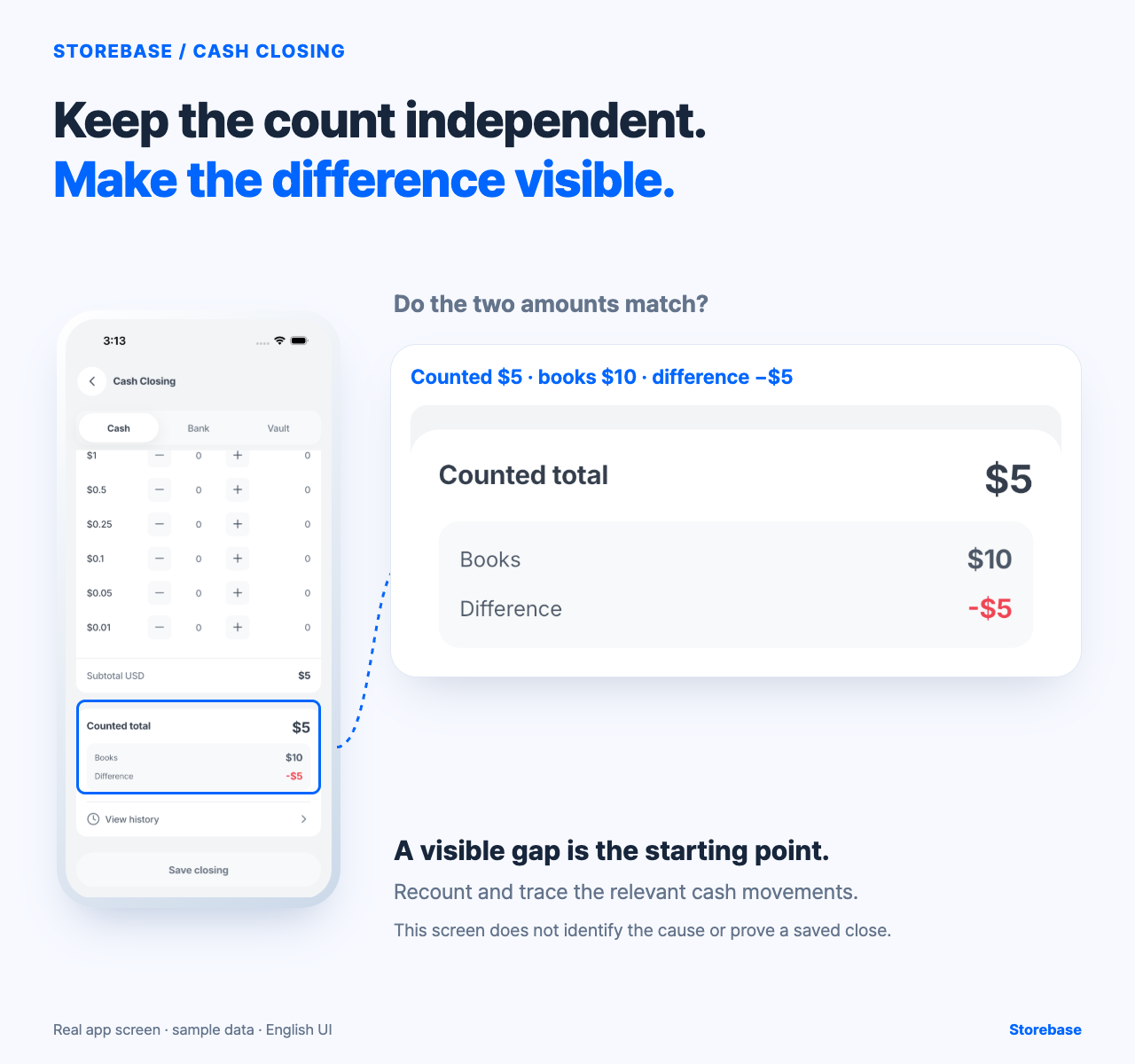
At Storebase’s cash-closing screen, enter the counted total and compare it with the books total; the visible difference gives the owner a concrete exception to investigate and hand off. Recount and trace the related cash movements—the screen does not identify the cause or prove the close was saved.
Close the issue with a recheck
Record the correction reason and verify the result at the next close. Set reporting thresholds for your operating scale and risk, but never use them to omit discrepancies from records.
The owner should receive clear exceptions that need a decision, not every routine closing notification.
Separate the cash investigation from the escalation route
A discrepancy has two parallel paths. The investigation path reconstructs what happened; the escalation path decides who may act next. Mixing them makes the amount do too much work: a small unexplained pattern can stay local while a familiar large difference is sent upward with no useful question. Give each case a stable reference and preserve four times separately: when the cash moved, when it was counted, when the difference was noticed and when the case was handed over. Then classify the handoff by the decision required.
| Case state | Local responsibility | Reason to escalate | What the owner or senior reviewer receives |
|---|---|---|---|
| Source record found and correction is within policy | Assigned closer corrects through the approved route | No escalation; retain the correction trail | Included in the scheduled exception review |
| Evidence is missing but still obtainable at the store | Manager names the missing record and its custodian | Deadline passes or access is blocked | The unresolved fact, attempts made and access needed |
| Pattern repeats across shifts or drawers | Manager compares the common step, not just the people | A rule, control or role boundary may need changing | Pattern summary and the proposed operating change |
| Safety, suspected misconduct or authority limit is involved | Preserve evidence and stop informal editing | Escalate immediately under the store's policy | Facts only, protected evidence and the decision requested |
This structure keeps an ordinary counting error close to the work while protecting serious cases from casual handling. The reporting threshold determines the route and urgency; it must never erase the underlying discrepancy or turn an unverified suspicion into a finding.
Test the route with a close the owner does not attend
Choose one drawer and run one closing cycle with the normal closer and manager, while the owner stays out of the first response. Before the shift, agree on the evidence the closer may inspect, the correction they may make, the manager's decision boundary and the conditions that require immediate escalation. Do not seed a fake shortage or surprise the team. Use the next naturally occurring difference, including a zero difference, to observe the process.
Review the cycle in two passes. First ask whether the expected amount can be rebuilt from the opening basis and recorded movements without a private message to the owner. Then ask whether the named person closed the routine case or delivered a decision-ready exception before its deadline. A zero difference passes the arithmetic check only; it does not test the escalation route unless the required close record and custody handoff also exist.
If the owner has to identify the transaction, find the person or decide an action that the manager was meant to own, record the exact missing dependency. Change only that evidence rule, access boundary or decision rule, then repeat another ordinary close. The useful result is not fewer messages on one night. It is a case that another responsible manager can reconstruct and route without borrowing the owner's memory.
Use the Storebase difference as a starting signal, not a verdict
The visible comparison between counted cash and the books can establish that a closing case exists and give the team a shared amount to discuss. It does not establish why the difference arose, who caused it, whether a related movement is missing or whether a submitted close persisted correctly. Keep those claims outside the screen evidence until the supporting transaction, custody record and saved result have been checked.
A manager should attach the case reference to the operating record used by the store, note the next action and leave it open until the stated closing evidence is present. The owner then sees only cases that cross the agreed authority, risk or evidence boundary, together with a specific decision request. Storebase can support the visible comparison already described; the policy, investigation, protected handling and final accounting judgment remain human responsibilities.
Watch for one regression after the new route is introduced: a quieter owner inbox may mean staff are resolving ordinary cases, or it may mean differences are no longer being recorded. Compare the number of completed close records with the expected closes, and inspect whether locally closed cases still retain their correction reason and recheck. Quiet is useful only when the trail shows that the work was completed.