
STOREBASE INSIGHTS · Multi-location operations
Closing checklists: a completed task still needs a clear review
Separate a completed closing checklist from a reviewed close. An employee finishing an entry and a manager checking its evidence are different states. One shared checkmark can let unresolved issues pass into the next day.

On this page
What does “done” actually mean?
Cash may have been counted without being compared with the expected amount. A return may have been entered without a transaction reference. Before adding more checklist items, define what completion means for each one.
Use distinct states
| State | Required record |
|---|---|
| Prepared | Required entries and supporting evidence |
| Reviewed | Reviewer and review time |
| Exception open | Unanswered question, owner and deadline |
A manager should not re-enter every number. Review the evidence and return only the unresolved part. An unreviewed close should also remain distinguishable from one that passed review.
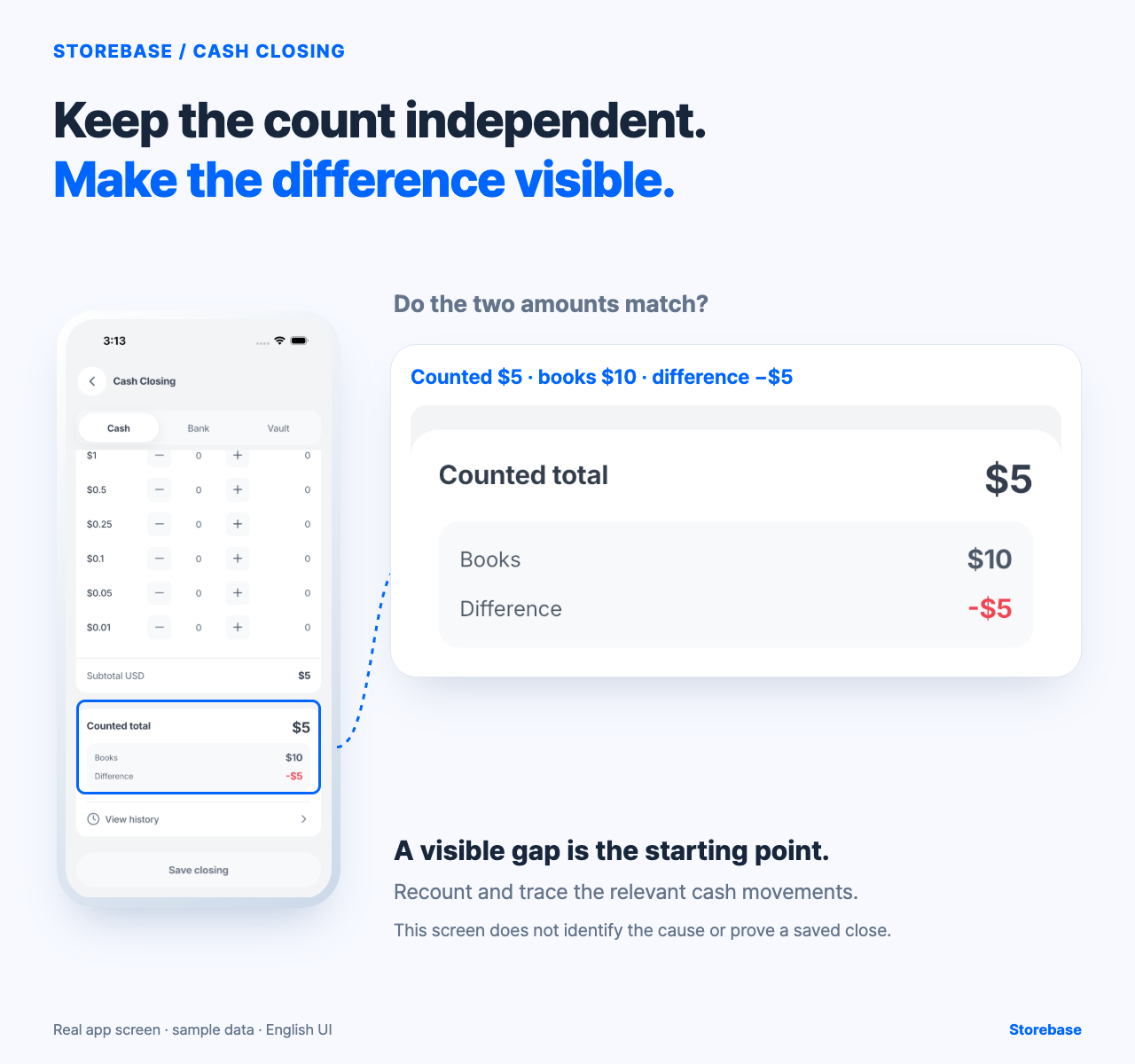
For a closing checklist, Storebase’s cash-closing screen can show one concrete exception—the counted amount against the books—so the reviewer knows which question to carry forward. It does not show separate prepared, reviewed, and exception states; keep the review record until those states are demonstrated.
Start tomorrow with unresolved work
Check that open items reach the next responsible person. If your tool cannot represent the states separately, attach a separate review record. An automatically sent closing report is not automatically verified.
When preparation and review are visible across stores, the owner can focus on exceptions rather than rereading every checklist.
Make the review a decision, not a second performance of the close
The closer prepares the evidence; the manager decides whether the close is acceptable. Repeating every count and entry may feel thorough, but it turns review into duplicate labor and still leaves unclear who made the final judgment. Build a compact closing packet instead: source time, expected value, observed value, difference, explanation or missing evidence, preparer, and the item that needs a manager's authority. The reviewer checks whether the sources agree, whether explanations fit the evidence, and whether anything remains unsafe to carry overnight.
Use risk to choose review depth. A close with no difference, complete source records, and an experienced preparer may receive a concise evidence check. A cash variance, refund without support, late edit, missing key or device, repeated discrepancy, or unfamiliar closer deserves a deeper look under the store's policy. Sampling should never mean guessing: the rule for expanding the review must be written before the manager sees the result. When an item crosses that boundary, the packet should show exactly which source needs inspection.
A completed checklist therefore needs three distinguishable outcomes: accepted, returned for correction, or accepted with an open exception owned for the next step. “Seen” is not one of them. Each outcome carries the reviewer, decision time, and reason. This prevents a tick made by the preparer from being mistaken for management approval.
Return the item without erasing the first attempt
When evidence is incomplete, the manager should return the specific item rather than reopen the whole close through a phone call. Preserve the submitted value and its time, add the question or reason for return, identify who must respond, and set a deadline based on the risk. The closer then attaches a correction or explanation as a new step. The reviewer accepts or escalates that response. Keeping the first submission visible makes coaching possible and prevents a clean final number from hiding how it was reached.
Responsibility follows the decision. The staff member remains accountable for preparing accurate source information; the manager remains accountable for reviewing within the agreed boundary and handling matters that exceed staff authority. Saying that a junior employee failed does not finish the manager's work. The review record should show whether the manager detected the problem, returned it clearly, supplied or obtained the needed authority, and verified the outcome. Repeated preparation errors may require training or a process change, but they do not transfer the review duty downward.
For urgent unresolved risk, write the temporary control as well as the next owner: for example, restrict access, preserve evidence, separate disputed cash, or delay a nonessential action when policy permits. These are operating decisions, not claims that a checklist or application makes them automatically. Legal, safety, disciplinary, and accounting consequences remain with qualified people under the rules that apply to the store.
Run three closings and ask a fresh manager to reconstruct them
Test the method on three different closes: one ordinary, one with a resolvable discrepancy, and one that must remain open overnight. Do not brief the reviewer privately. For each packet, note whether the source was sufficient, why the chosen review depth applied, what decision was made, and who owned the next action. The following morning, verify that the open item appears before routine work and that any temporary control was removed only after its condition was satisfied.
The available Storebase cash evidence shows an expected amount beside a counted amount and a resulting difference in a sample view. It does not establish that the product records the packet described here, distinguishes prepared from reviewed, routes a return, assigns exceptions, locks a close, or preserves every edit. Test those capabilities and permissions directly before making them part of the control. The visible comparison can be a useful source signal; management acceptance is a separate human decision.
For the regression gate, give one completed packet to a manager who did not participate. They should be able to identify the original evidence, preparer, review outcome, corrections, unresolved period, and final closure without asking the owner what happened. If the final figure is tidy but the route to it cannot be reconstructed, the close is numerically quiet and operationally weak.
Related resources
See how Storebase connects multi-location work
Cash closing exceptions: when should the owner be involved?
Store incident reports: send the information needed for a decision