
STOREBASE INSIGHTS · Sales and finance
Give the bookkeeper a source record, not a three-month mystery
Keep each transaction with its date, amount, account, purpose and supporting document while the work happens. A transaction history lets a bookkeeper start from recorded entries instead of guessing months later, but it does not replace source documents, corrections, reconciliation or professional tax judgment.

On this page
The expensive part is guessing later
A backlog of transactions turns a normal bookkeeping task into detective work. One charge might be an advertisement or a payout. A payment might belong to another period. If the owner remembers only the total, the bookkeeper has to stop and ask for the missing story before the entry can be used. The work is not solved by adding another spreadsheet tab after the fact.
The practical standard is simple: record the source context close to the transaction. The person who made or approved the movement usually knows the purpose best. Leave enough information that another person can understand what happened, where it belongs and which question is still open.
What a source record should answer
| Question | Useful entry | Follow-up that remains human |
|---|---|---|
| What happened? | Transaction type and short purpose | Compare with the source document |
| When did it happen? | Date and relevant period | Check cutoff and bank posting |
| How much? | Amount and account | Reconcile to statement or receipt |
| Who knows why? | Actor, requester or approver | Confirm authorization |
| What is missing? | Note or attachment reference | Ask for the document and resolve it |
Do not fill an unknown field with a guess. Mark it open and assign someone to answer it. A visible missing explanation is safer than a confident but invented category.
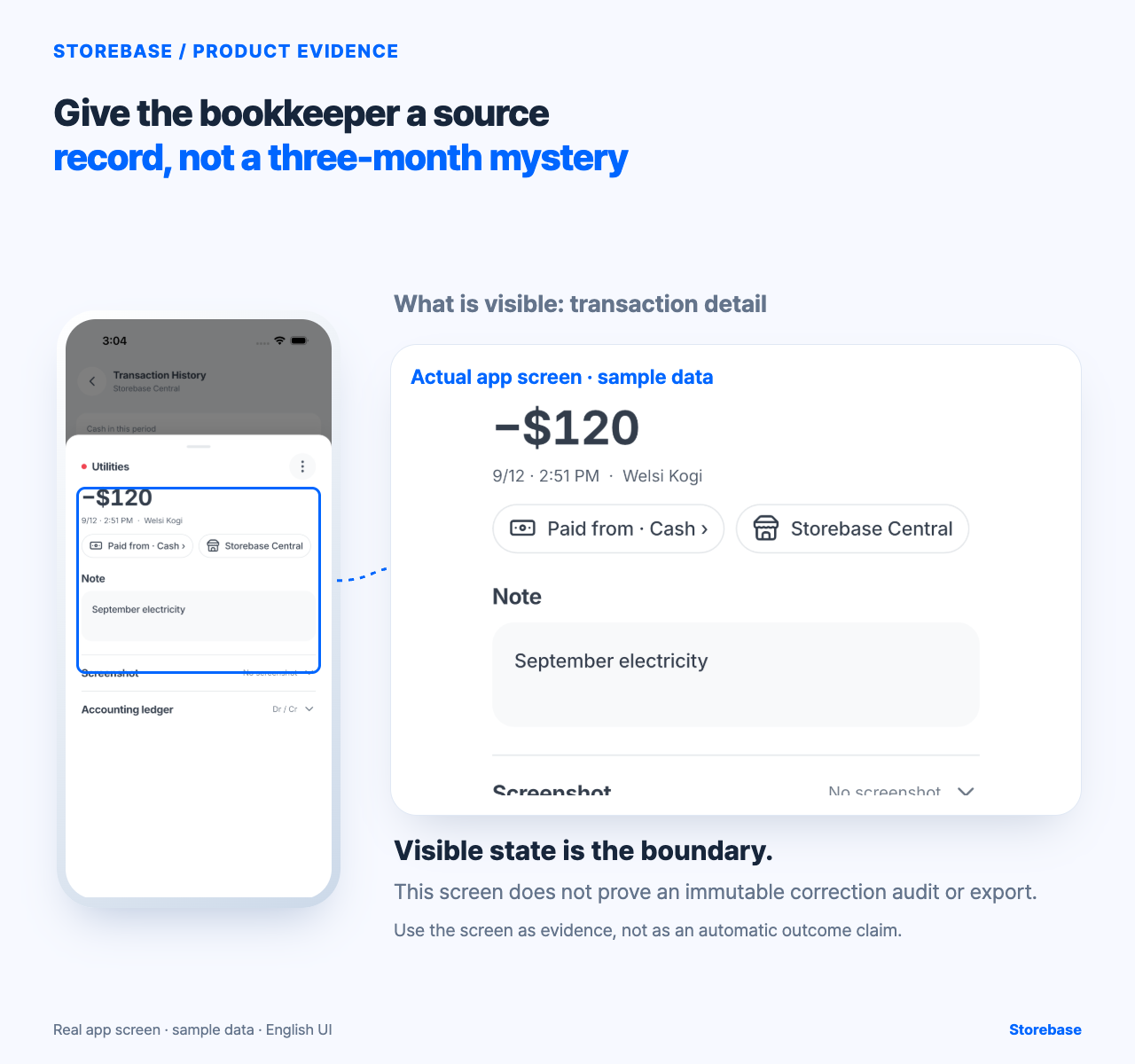
Where Storebase can help
Storebase’s transaction-history feature is intended to keep transaction records available for later inspection, with transaction detail and history context rather than a blank spreadsheet row. That gives a bookkeeper a place to begin: find the entry, inspect its amount/date/account context, then ask the responsible person for the missing source.
The record is a handoff aid, not an accounting verdict. It does not by itself prove that every transaction is immutable, that a correction history is complete, or that the business has satisfied a tax record-keeping rule. Keep invoices, receipts, statements and approvals according to the applicable policy, and involve a qualified bookkeeper or accountant when classification matters.
A clean handoff routine
- Set the opening date for the catch-up period and preserve prior reports.
- Ask the person who made the movement to add purpose, account and source-document reference.
- Review transaction history for blank, duplicate or unusually dated entries.
- Export or share the agreed source records with the bookkeeper through the approved access process.
- Let the bookkeeper list unresolved questions rather than silently reclassifying them.
- Keep the final explanation with the transaction so the next review starts from the same record.
Check the result
At the next handoff, choose five entries at random. Can the bookkeeper identify what happened, when, how much, which account, who can explain it and what evidence remains? If yes, the source record is doing its job. If not, improve the moment of entry or the owner assignment before buying more cleanup hours.
The conditional benefit is continuity: the owner may spend less time retelling old transactions, while the bookkeeper gets a clearer starting point. It is not a promise that every backlog becomes correct automatically or that professional review is unnecessary. For tax, statutory reporting and disputed transactions, confirm the appropriate local authority and qualified advice.
Give each document a traceable route into the books
A source file becomes usable when its custody is visible. Assign a stable reference at receipt and keep the document date, arrival date, sender or capture source, related transaction, file version, current custodian, and access classification. These dates answer different questions: a receipt may describe an earlier purchase yet arrive after the period review. Preserve both rather than changing the transaction date to match the upload.
Link one document to every transaction it supports and every transaction to the evidence expected for it. Allow one-to-many relationships because a statement can support several entries and one purchase can require an invoice, approval, delivery evidence, and payment record. Mark the relationship type so another person knows whether a file proves authorization, occurrence, amount, settlement, or only provides context. A folder full of documents is not a chain of evidence if nobody can tell which claim each file supports.
Protect the original from casual editing, but do not promise immutability without testing the system. A replacement or corrected file should receive a new version with the reason, submitter, review status, and link to the superseded copy. Restrict sensitive payroll, identity, customer, and banking material to people who need it, while giving the bookkeeper an approved route to request access instead of moving records into private chat.
Close the bookkeeper's question back at the transaction
Treat every returned question as a small case. Record the transaction reference, exact missing fact, question date, responsible operational person, response due, answer source, bookkeeper decision, and closure time. “Please clarify” is too broad; ask whether the purpose is unknown, authorization is absent, the amount conflicts, the period is uncertain, or the source cannot be read. Different gaps should go to different people.
Test the route with five entries chosen across ordinary purchase, refund or credit, owner-related movement, period-boundary item, and one missing document. Have the bookkeeper submit questions through the agreed record rather than a side channel. After response, ask a second reviewer to reconstruct which source supported the final treatment and which judgment remained professional. Reopen one corrected entry and confirm that the first document and first question are still visible.
The evidenced Storebase transaction-history description gives a later inspection point for transaction context, as the article states. It does not establish public-safe source-document capture, stable references, document versioning, complete edit history, bookkeeper question routing, access approvals, export fidelity, reconciliation, or compliance with retention rules. Verify these behaviours before depending on them. The regression gate is the next period handoff: no resolved question should return merely because its answer was left in one person's inbox.
Related resources
Explore Storebase financial reports and record-keeping
Turn receipt cleanup into a routine before the backlog grows