
STOREBASE INSIGHTS · Sales and finance
Turn receipt cleanup into a routine before the backlog grows
Start receipt capture when books are current, then keep each new expense linked to its receipt. That prevents a one-to-three-year cleanup from depending on documents nobody can find.

On this page
A backlog is a process problem, not a character test
When a bookkeeper asks for one to three years of receipts, the work can stall because nobody can find the documents and the owner stops responding. The better moment to start receipt capture is when the books are current. Then each new expense has a small context before it becomes a large cleanup.
The first rule is to separate recovery from prevention. For the old backlog, make a list of missing documents and decide which items matter most. For today forward, record the receipt with the expense while the purpose and person are still known. Do not promise that a missing receipt can be recreated from a report.
Use a small receipt routine
| Step | Record | Human check |
|---|---|---|
| Capture | Receipt image or reference | Is it legible and complete? |
| Describe | Vendor, purpose and period | Does it match the purchase? |
| Link | Transaction and account | Is the amount and currency right? |
| Escalate | Missing or unclear item | Who will request the document? |
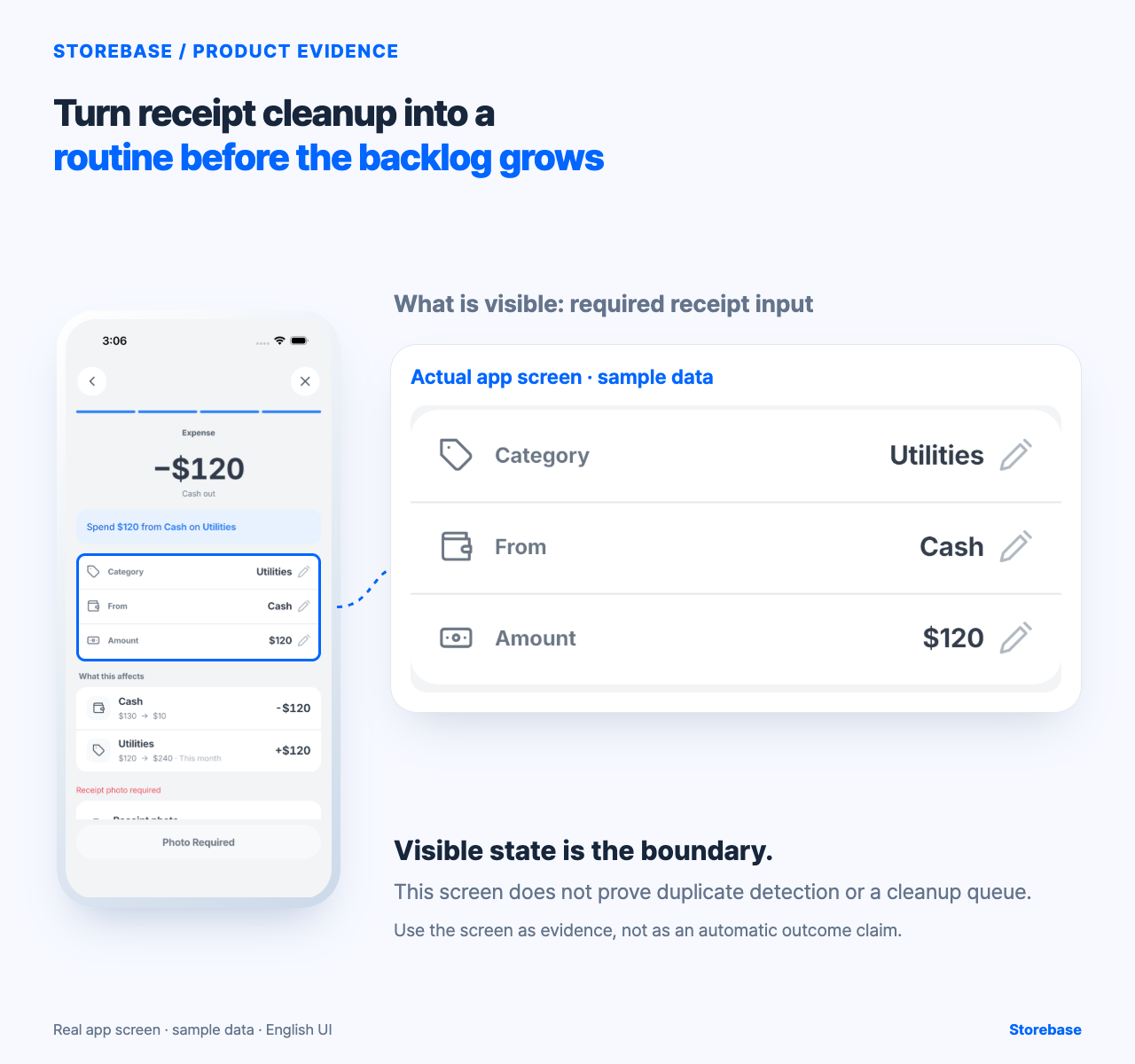
What Storebase can contribute
Storebase’s receipt and transaction records keep an expense connected to its context so a team can return to it. Use that as a capture habit for current books: keep the expense, receipt reference and open question together. It does not recover documents that were never captured, decide tax deductibility, or prove every receipt is authentic.
For a backlog, start with a bounded period. Mark each item found, missing, duplicate or needing professional review. For new work, ask the person making the purchase to attach the receipt before closing the task.
Check the result
After four weeks, sample five new expenses. Can another person find the receipt, vendor, purpose, amount, period and unresolved question? If not, repair the moment of capture. Keep missing items visible and ask qualified accounting advice about required evidence and retention.
Keep one missing receipt visible
Choose one old expense without a document, write the vendor, amount, period, owner and date requested, and leave it marked missing until the file is found or a responsible reviewer decides what to do. Do not fill the gap with an invented attachment or a guessed tax treatment.
Sample the next four weeks
For four weeks, sample new expenses and check for a receipt reference, vendor, purpose, amount and period. Compare the missing count with the prior routine. A lower count is useful evidence of better capture, not proof that the old backlog is recovered.
Give every old charge an evidence grade and a stopping rule
A cleanup becomes endless when every unmatched charge is treated as though the perfect receipt must eventually appear. Define acceptable evidence with the responsible accountant before reviewing the batch, because requirements vary by jurisdiction, transaction and purpose. One item may have an original document; another may have a supplier copy plus payment evidence; a third may have only a bank description and staff recollection. Keep these grades distinct. A weak substitute should never be relabeled as an original, and a plausible business story should not be mistaken for proof.
For each unresolved charge, record the period, source account, candidate vendor, amount and currency, evidence presently available, request recipient, request date and the decision deadline. At that deadline, an authorized reviewer chooses whether to seek more evidence, use a permitted alternative, leave the accounting treatment open or obtain professional advice. A stopping rule does not make missing proof acceptable. It prevents the same request from circulating indefinitely while the books appear cleaner than the underlying evidence. Preserve the unresolved status and the basis for whatever treatment follows.
Prioritize using consequence rather than visual neatness: statutory or filing relevance, material amount, suspected duplication, unclear personal benefit, an unreconciled bank movement or a supplier relationship that can still produce a copy. This directs scarce review time to decisions that could change the books. The owner should see the few cases that exceed policy or professional authority, not a folder count that says nothing about the remaining risk.
Run recovery and current capture as two protected lanes
Assign separate capacity to the historic batch and to today's purchases. The person clearing old records must not be allowed to consume the time or access needed to capture current documents. Mark a fixed cutoff, give each lane its own queue owner, and review them with different measures: the historic lane tracks cases reaching an authorized disposition, while the current lane checks whether context is present before memory and supplier access fade. Combining both into one large inbox lets yesterday's volume recreate tomorrow's backlog.
At the end of each review cycle, sample the boundary itself. Choose charges just before and just after the cutoff, verify that none vanished between queues, and confirm that corrections did not detach a current document from its transaction. Also inspect a found item, an unresolved item and an approved alternative so another reviewer can reconstruct why each reached its state. If that cannot be done, repair ownership or evidence requirements before increasing throughput.
Reviewed Storebase source confirms only a structured presentation and verification status for receipt attachments after analysis. It does not prove immutable history, statistical checking, actor attribution or recovery of a document that was never captured; there is no explicit mapped screen for the broader claim. Use observed receipt data where available, but keep backlog disposition under the store's approved accounting process. The operational gain is a sealed boundary: old uncertainty is worked down without allowing new evidence to enter the same uncontrolled pile.
Related resources
Explore Storebase financial reports and record-keeping
Give the bookkeeper a source record, not a three-month mystery
When a receipt looks wrong, compare it before accusing anyone