
STOREBASE INSIGHTS · Sales and finance
Store expense categories: collecting receipts is not enough
If store expenses are repeatedly misclassified, separate receipt collection from classification review. A receipt helps establish what was bought; it may not establish why it was bought or which store used it. Compare the amount, purpose, store and category definition. When an error is confirmed, explain the correction to the person entering it and check the next similar expense. Renaming categories at month-end does not, by itself, change the process that caused the mistake.

On this page
- Why do you still need to ask questions when the receipt is there?
- What does a receipt tell you—and what still needs context?
- Go beyond “changed supplies to meals”
- Start with one expense type if records are incomplete
- Do OCR and templates remove the need to check categories?
- Make the next month-end less dependent on memory
Why do you still need to ask questions when the receipt is there?
Imagine several stores submitting receipt photos and entering expenses. At month-end, a meal receipt appears under supplies. The owner asks again who bought it and what it was for. This is an illustrative situation, not a customer's actual expense record.
The missing piece may not be the photo. The person entering the expense may misunderstand a category, reuse a previous transaction's classification, or encounter several purposes on one receipt. Asking for more diligent receipt collection does not resolve those different causes.
When “entered” and “checked” mean the same thing, verification becomes the owner's month-end job. Storebase's perspective is not to make the owner faster at correcting labels. It is to help the team understand what to check and carry that learning into the next entry.
Storebase connects sales, inventory, team and financial workflows for multi-location owners. This article proposes an internal expense-management practice. It does not determine tax deductibility or prescribe statutory accounting categories.
What does a receipt tell you—and what still needs context?
A readable amount and item description do not automatically establish business purpose. Purchases from the same merchant can be store supplies, a staff meal or goods for resale.
| Check | Evidence | If it is unclear |
|---|---|---|
| Date and amount | Readable receipt and payment record | Recheck the original or matching payment |
| Items bought | Receipt line items | Request a complete image or explanation |
| Purpose | Purchaser's or user's account | Ask instead of guessing a category |
| Store attribution | Actual use and request or approval context | Separate the paying store from the store using it |
| Category definition | Agreed internal rule | Add an example for an ambiguous case |
A receipt with mixed purposes may need more than one classification. Zoho Expense's official guidance describes itemizing a single expense or receipt into different categories. This illustrates the distinction; it does not mean every system offers the same input method. Multiple categories and itemization
Go beyond “changed supplies to meals”
Consider a hypothetical internal-management example. These category labels are illustrative, not tax-accounting instructions.
An employee at Store A enters a meal receipt as supplies. Seeing food names is not enough to conclude it was a staff meal. The reviewer asks who used the purchase and why. If the explanation and evidence confirm a staff meal, an authorized person corrects the category under the internal rule.
Then explain why: this purchase had that purpose, so this definition applies. Find out why the original selection was made. Otherwise the next receipt may follow the same path.
| Confirmed cause | Change to make | Check next time |
|---|---|---|
| Category name was misunderstood | Add a short definition and concrete example | Can the next similar expense be classified correctly? |
| Previous category was reused without review | Add a purpose check when copying or using a template | Were purpose and store checked, not only amount? |
| Receipt contains different purposes | Check the supported way to separate items | Do the separated amounts reconcile to the original? |
| Receipt is blurred or cropped | Request readable evidence at entry | Can the next reviewer understand it without another request? |
Do not assume carelessness or blame from the category alone. The definition itself may be ambiguous. Keep the before-and-after classification, evidence and responsible person together so another reviewer need not repeat the investigation.
Start with one expense type if records are incomplete
Trying to explain every old expense at once can push the work straight back to the owner. If evidence or rules are missing, choose one frequently used category that often causes confusion.
- The person entering the expense records date, amount, store, a short purpose and supporting evidence.
- A designated reviewer compares purpose with classification. Matching the amount is not the whole check.
- Return incomplete entries with a specific question, such as “purpose not yet confirmed.”
- An authorized person corrects the entry after checking and explains the reason.
- Review the next similar expense. If the issue repeats, revisit the rule or input process.
Choose review frequency according to transaction volume and risk, but ask while the purchaser still has the context. This does not require the owner to approve every entry. Define what a local reviewer can resolve and which exceptions require escalation.
Do OCR and templates remove the need to check categories?
Reading text and amounts from an image, understanding a purchase's purpose, and approving its classification are different tasks. Even correctly extracted text can leave purpose or store attribution unresolved. This article does not claim that AI can automatically correct every receipt category.
Storebase's public finance guide describes following related transaction records and reusing saved transaction settings through templates. Templates can reduce rebuilding a recurring expense from scratch, but the person entering it still needs to check that the saved setup fits this purchase. Saving a template alone does not record an expense or schedule a payment. Storebase finance guide
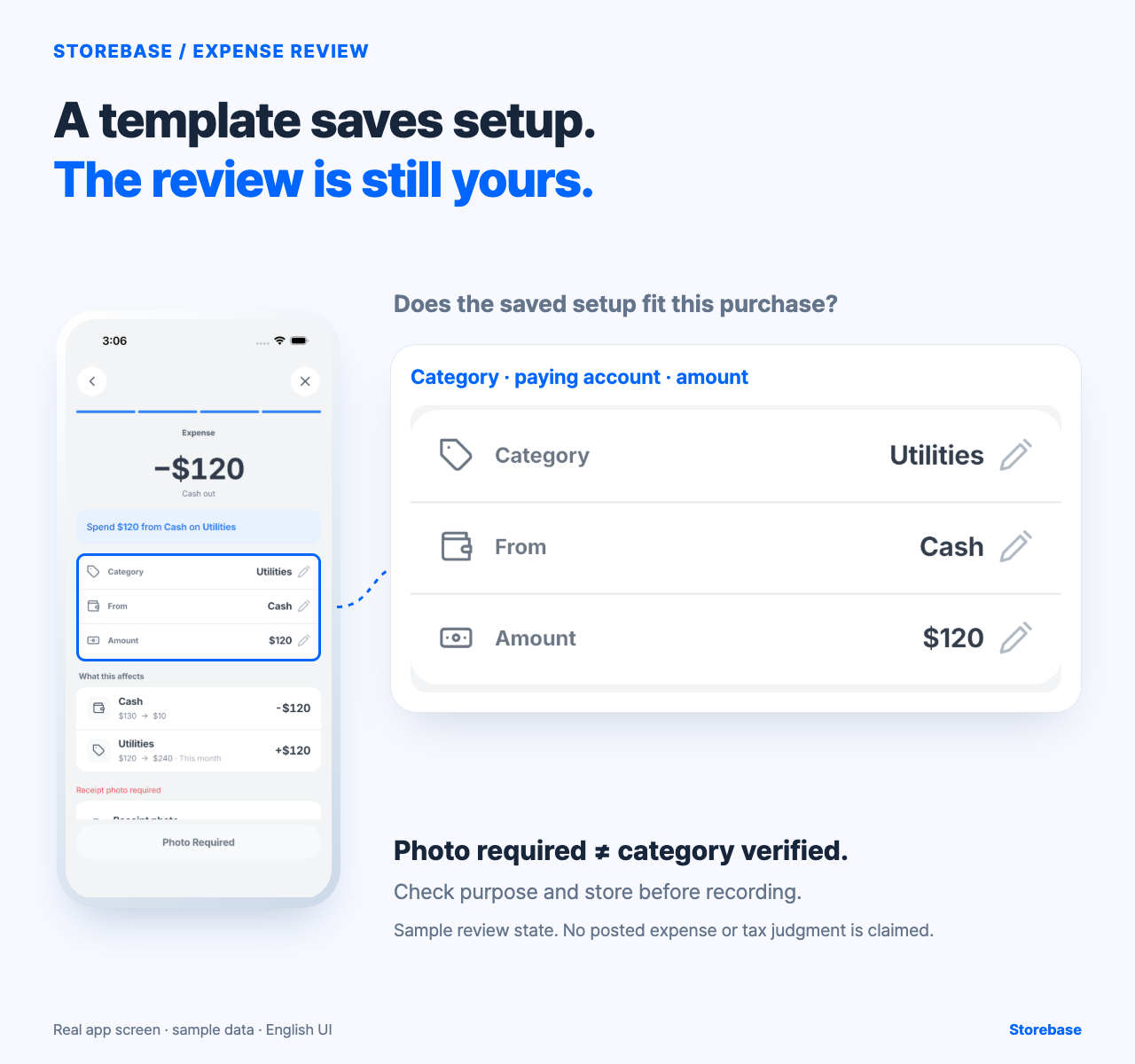
The worksheet here is not a claim that the product automatically detects every category error or provides tax judgments. Check available screens and permissions before adopting the workflow. People remain responsible for definitions, unclear purposes and evidence review. Explore Storebase transaction records and templates
Make the next month-end less dependent on memory
For one expense type this week, keep evidence, purpose, store, category, review status and next responsible person connected. Do not mark an unresolved entry complete. Say what is missing and who will check it.
Separate the person setting the rule, the person entering the purchase and the reviewer authorized to correct it. Escalate conflicting purposes, recurring unresolved classifications and decisions outside local authority. Limit access to personal and payment information to people who need it for their work.
The first useful sign is not a larger collection of receipt photos. It is that the next person understands the reason for the category and the next reviewer can continue without asking the owner to rebuild the story. That is a result to test, not a measured improvement claimed here.
Expense management should not turn the owner into a more meticulous data-entry clerk. When checking and learning happen on site, month-end can become a time for necessary exceptions rather than reconstructing everyone's memory. That is how the process can support more freedom over your time outside the store.