
STOREBASE INSIGHTS · Inventory management
How do you decide what to reorder when stock looks low?
Do not reorder from a low-looking number alone. Start with the item’s unit, recent movement, confirmed balance, supplier lead time and a stated minimum. A stock review can surface candidates, but a person still checks evidence and approves the order.

On this page
A low number is a prompt, not an order
A bottle showing three units may need replenishment—or it may be reserved, in transit, or counted in a different unit. First ask what the number includes. Record one SKU, location, cutoff time and unit. If the history is incomplete, say so rather than treating a guess as demand.
Build a provisional minimum from movement
Gather the last confirmed count, receipts, sales, transfers, damage and returns. Mark the period and unusual events. Then write a provisional minimum using observed consumption and supplier lead time. This is a working rule, not a universal formula. A fast-selling item with a long lead time needs a different review point from a slow item delivered tomorrow.
| Check | Question |
|---|---|
| Unit | Is this each, case, bottle or pack? |
| Movement | What left or arrived after the count? |
| Lead time | How long until usable stock arrives? |
| Exception | Was there promotion, damage or transfer? |
The core lesson is about handoff. A spreadsheet that combines input, lookup and analysis makes the person updating it responsible for interpreting it too. Separate the movement record from the decision rule so another manager can review the same evidence.
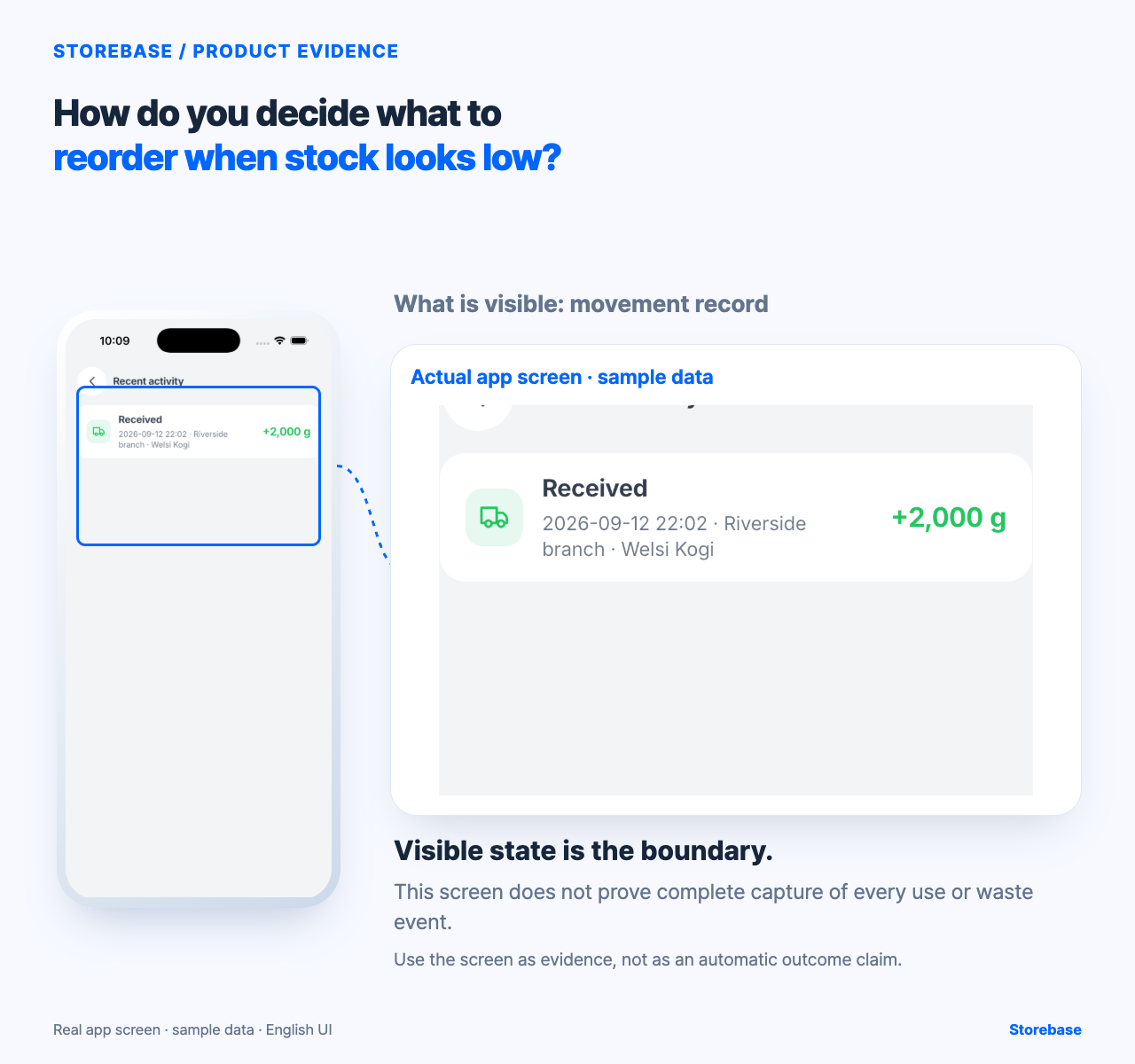
Review reorder candidates in Storebase
Use Storebase's reorder review to surface an item that deserves attention, then compare the candidate with the confirmed count, movement record, unit and provisional minimum before ordering. Staff can prepare the record, a manager checks the assumptions and the owner handles an unusual quantity or supplier change.
A candidate list supports a human decision; it does not provide an automatic forecast, place the order, confirm the supplier or make the minimum correct for every season. Recheck ordered, received and usable quantities after delivery.
A practical handoff is: staff record movement, a manager checks the candidate and assumptions, and the owner handles unusual quantities, supplier changes or a new minimum. After delivery, compare ordered, received and usable quantities. If results repeatedly differ, revise the recording process or the rule; changing the threshold alone may hide the cause.
Start with one item today. Write the cutoff, unit, confirmed balance, movements, lead time, proposed minimum, approver and next check date. The benefit is a decision another person can inspect—not a promise that every reorder will be right. As the routine becomes reviewable, the owner can reserve attention for exceptions instead of rebuilding the same stock story.
A worked review
Suppose a café sold 18 bottles over six days, received 24 and counted 10 at close. The arithmetic is useful only if the count and unit are comparable. Ask whether two bottles are reserved, whether a transfer left the store, and whether the delivery has been posted. Write each answer beside the number. Then choose a review point that covers expected consumption during the supplier lead time plus a buffer you can explain. Review that assumption after the next delivery rather than quietly changing it.
A checklist for the next decision
- Freeze the date, location and unit.
- Confirm the physical count and distinguish available from reserved stock.
- Trace receipts, sales, transfers, damage and returns.
- Note lead time and unusual demand.
- Record the proposed minimum and the person who approves.
- Recheck ordered, received and usable stock after delivery.
If the same item keeps crossing the threshold unexpectedly, investigate missing movement records or a wrong unit before buying more. A reorder list is an aid to judgment, not evidence that the root cause is solved.
The owner’s freedom comes from a trail that another person can read and test. It does not mean the owner stops caring about stock; it means routine evidence is prepared before an exception reaches them.
Do not use revenue as a substitute for movement. Revenue can rise while one location is quietly losing units, and a low balance can reflect a delayed receipt rather than true depletion. Record the reason for every exception and leave the next reviewer a date. If the supplier changes its pack size, reset the unit comparison before calculating a new minimum. These small definitions protect the decision from becoming a private rule in one person’s head.
Separate the consumption clock from the replenishment clock
A reorder rule compares two timelines. The consumption clock estimates how quickly usable stock leaves under comparable conditions. The replenishment clock runs from an authorized order through supplier acceptance, transit, receiving, inspection, and availability for sale. Treating quoted lead time as the whole second clock can place the review too late. Likewise, sales observed during a stockout understate unconstrained demand because customers could not buy what was absent. Mark lost-availability periods, substitutions, promotions, closures, and pack changes before using movement to revise the rule.
Choose the evidence window by relevance, not convenience. Keep a stable baseline distinct from a temporary event overlay, and state which one the approver used. Supplier minimums, case packs, shelf capacity, expiry, cash constraints, and transfer options remain decision constraints rather than hidden adjustments to the consumption figure. This structure does not produce one universal equation. It makes the chosen review point explainable and shows which assumption must be revisited when the outcome differs.
Shadow-test a challenger rule for one replenishment cycle
Before replacing an established review point, run the proposed rule beside it without allowing both to create orders. For each alert, preserve the incumbent recommendation, challenger recommendation, inputs available at that moment, manager decision, and reason. After receiving, compare whether each rule would have created an avoidable stockout, excess, missed transfer, or unusable quantity. Do not declare a winner solely because one cycle happened to favor it; use the test to find assumptions and repeat where the business risk justifies it.
Storebase's verified product description says sales movement can produce days of cover, surface low-running items, turn selected items into a supplier order, and support moving stock from another store. It does not establish that seasonal or event demand is modeled, that every sale and receipt is complete, or that a surfaced candidate is the correct purchase. During the shadow test, compare the visible candidate with confirmed movement, usable balance, supply constraints, and another-store availability. The manager owns routine selection; a material model disagreement or supplier change goes to the designated authority. The owner gains freedom only after the rule can be challenged and reviewed by others, not simply because an alert appears.
Related resources
Explore Storebase inventory features and their scope
How do you buy from a stock snapshot when movements are still in flight?