
STOREBASE INSIGHTS · Inventory management
Checking supplier invoices: match the order, receipt and bill
Check a supplier invoice against both the order and what was actually received. An invoice arriving does not prove that every ordered item arrived or that the charge matches the agreement.

On this page
Three records answer different questions
The order records what was requested. The receipt records what arrived. The invoice requests payment. Partial deliveries and returns can legitimately create differences in dates and quantities. A difference is a question to investigate, not automatically an error.
Review the mismatched lines
| Difference | First question |
|---|---|
| Quantity | Outstanding delivery, partial delivery or entry error? |
| Unit price | Different agreed price or applicable condition? |
| Additional amount | Linked to agreed freight, discounts or other terms? |
Match item, unit and order reference before escalating unresolved lines. Do not label the entire invoice incorrect because one line needs clarification. Payment decisions still follow the agreement and approval process.
Carry the resolution into the next order
Keep the supporting document and the responsible person’s answer. Check whether the same condition is handled correctly on the next delivery. When selecting software, test whether the three records can be found together; do not assume automated matching or payment approval.
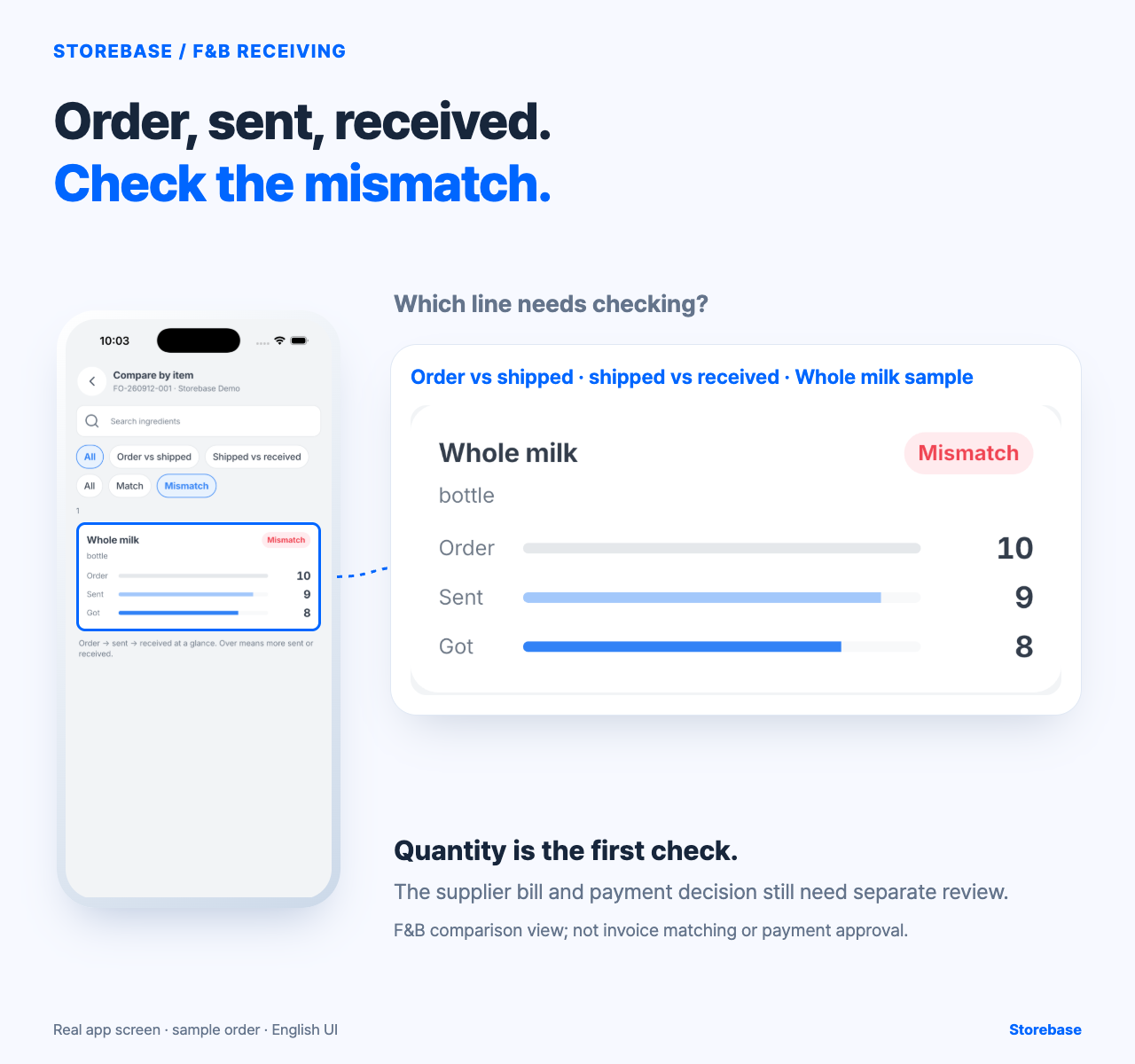
Storebase’s F&B Compare by item screen lets you switch between Order vs shipped and Shipped vs received, then filter mismatches; in the sample, Whole milk is 10 ordered, 9 sent, and 8 received. That gives receiving and purchasing a line to check against the supplier bill; it does not match an invoice or approve payment.
The benefit is not a larger document collection. It is a shared basis for the receiving and purchasing teams to finish checks without repeatedly involving the owner.
Normalize the line before deciding whether three records agree
A line can appear different even when the physical delivery is right, or appear equal while describing a different item. Before comparing quantities and prices, establish the supplier item reference, the store item, pack size, counting unit, conversion rule, currency, tax treatment and delivery location. Keep the original values as well as the normalized comparison. Twelve bottles, two packs of six and one case are not three opinions if the conversion was agreed; twelve individual units compared with twelve cases is a serious mismatch hidden by the same numeral.
Link partial events instead of forcing one order, one receipt and one invoice into a single row. A purchase line may arrive in several shipments, one delivery can be counted in parts, and an invoice can combine or split those events. Each received quantity should point to the delivery evidence and the order line it consumes; each billed line should identify what shipment or period it claims. Do not invent a neat link when the supplier reference is absent. Leave the relationship unresolved and request the missing basis.
Price and tax questions belong after identity and quantity are stable. A changed unit price may be authorized by a revised order, governed by a contract tolerance or simply wrong. Freight, deposit, discount and tax can also sit at document level rather than on an item. The checker should surface those questions, not silently distribute them across lines. Accounting classification and the amount eligible for payment remain decisions for the authorized finance process.
Give each exception a disposition and an independent owner
Classify the exception according to the evidence needed next: item identity, quantity received, condition, unit price, additional charge, duplicate billing or missing document. The buyer can explain what was authorized, the receiver can attest to what was counted and its condition, and accounts payable can verify what the supplier asks to be paid. When one person performed more than one role, require an independent reviewer for the disputed line rather than pretending the records are independent. A mismatch is a control signal, not proof of fraud or poor performance.
Record a proposed disposition for the affected line: accept with support, request a corrected invoice, await a credit, investigate the receiving record or escalate a contractual question. If policy and the supplier agreement allow an undisputed portion to proceed, preserve the disputed remainder explicitly; do not present that as universal advice to pay or withhold. The person with payment authority decides release timing. A receiver should not resolve a price dispute merely because the goods are already on the shelf, and a buyer should not overwrite a count to protect an order.
The owner needs the value, age, reason and decision deadline of open exceptions, not a second copy of every matched line. A recurring conversion error should go to item setup; repeated short delivery goes to supplier performance review; unexplained price changes go to purchasing and finance. This routing turns the check into a repair loop without making the software the judge of supplier intent or liability.
Prove the receiving slice before extending the Storebase claim
The controlled Storebase fixture captured a sequence with an order quantity, a lower shipped quantity and a still lower received count. It also showed separate comparison views for order versus shipment and shipment versus receipt, supporting the claim that recorded logistics differences can be surfaced by line. That is useful evidence for the physical side of the check. It is not a supplier-invoice reconciliation and does not authorize payment, validate tax, confirm a contract price or establish that every stock and journal consequence finished correctly.
The fixture was completed by one operator, so it does not prove buyer, shipper and receiver authorization separation. Damage handling, a blank receiving path, finish versus cancel behavior, order closure and any later ledger repair were not all completed in the same controlled run. Captured comparison values show the state observed at that moment; they should not be described as independently reverified final balances. Those limits need to remain visible wherever the example is used.
For a regression gate, create a test order with two shipment events, one partial receipt, one deliberately mismatched count and known item conversions. Have separate authorized users perform the roles where the environment supports them, then inspect the comparison after refresh and trace only the verified downstream effects. Add a mock invoice outside the product flow and confirm the team can keep its exception separate. Pass only the receiving behavior that was observed; leave invoice matching, payment approval and financial posting unclaimed until their own runtime evidence exists.
Related resources
Explore Storebase inventory features and their scope
How can a purchase order stay connected to what each store receives?
Who should verify a delivery when the received quantity is disputed?