
STOREBASE INSIGHTS · Team management
Staff feedback after a mistake: check the facts while they are fresh
Give staff feedback while the specific situation can still be checked. Separate the observed action, the applicable standard and the next step instead of accumulating complaints until month-end. Timely feedback does not mean reacting angrily on the spot.

On this page
Discuss an event, not a personality
“You are always careless” does not identify a changeable action. Establish what was missing from a particular task and whether a standard existed. Give the employee a chance to explain relevant circumstances or missing facts.
Agree on one next action
| Element | Useful form |
|---|---|
| Observation | A required receiving check was missing |
| Standard | Who was expected to check it, and when? |
| Next action | Perform and record that check on the next receipt |
If no standard existed, fix the process first. Address missing training or authority rather than treating every gap as an attitude problem. Deliver individual feedback in an appropriate private setting.
Check whether the change worked
Review the next comparable task. If the problem repeats, reassess the cause rather than repeating the criticism more forcefully.
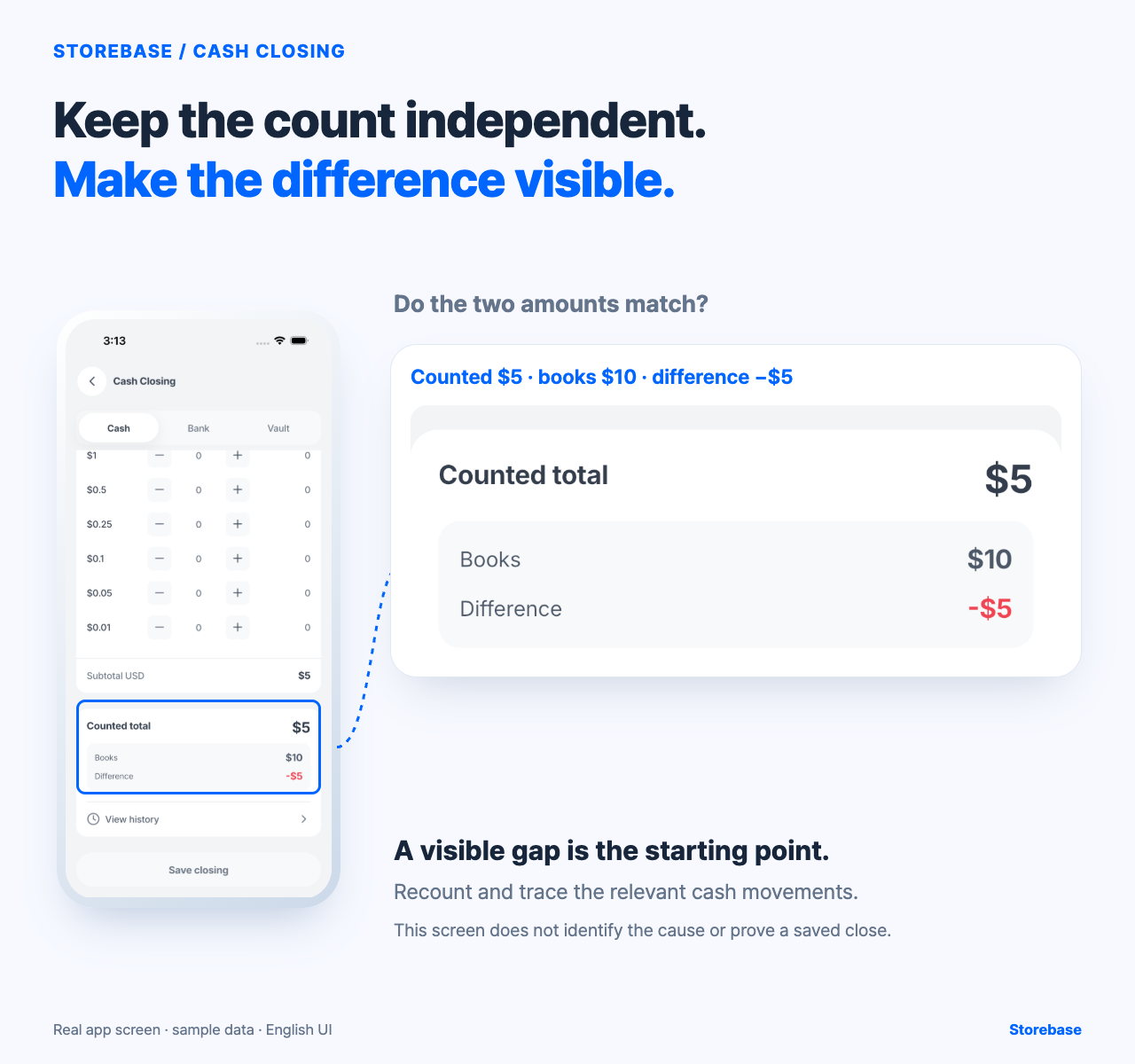
At Storebase’s cash-closing screen, enter the counted total and compare it with the books total; the visible difference gives a manager a concrete exception to discuss with the person closing the store. Recount and trace the related cash movements—the screen does not identify the cause or prove the close was saved.
The record should support coaching, not accumulate blame. The aim is for managers to coach specifically and employees to handle the next task without another instruction from the owner.
Choose the response lane before starting the conversation
Not every fresh exception should become a coaching talk. First decide whether the event is a routine skill gap, an unclear standard, a safety issue, a suspected policy breach or a matter that requires formal investigation. A manager can clarify a normal work method promptly; an immediate hazard may require stopping the task; an allegation involving misconduct, discrimination, retaliation, pay or protected conduct should move to the authorized employment process. Timeliness means preserving facts while they can still be checked, not rushing to a disciplinary conclusion.
Open with the observed event and the source that made it visible. State what was expected, invite the employee to describe conditions the record cannot show, and distinguish agreed facts from interpretations. If the standard was never taught, the correction belongs first to training or procedure. If equipment, staffing, access or a conflicting instruction shaped the outcome, assign that cause to the person who can change it. Do not convert a system discrepancy into a claim about attitude, honesty or intent.
Keep the setting private and the audience limited to people with a legitimate role. The employee should be able to correct a factual mistake and know what happens next. Any formal warning, schedule consequence, wage decision, suspension or termination must follow applicable law, contract, collective agreement and company policy; this operating method does not decide those outcomes. Where local rules or risk require it, involve qualified human-resources or legal review.
Leave a compact coaching record that supports the next observation
Write a short record after the discussion: the work event, the evidence reviewed, the employee's explanation, the relevant standard, the next action, the support promised and the date of the next comparable task. Separate a factual correction from a manager's assessment. Avoid unrelated health, family or personal details; record only what is necessary for the stated purpose and apply appropriate access and retention rules. The employee should have a route to challenge an inaccurate summary without having to agree with every managerial judgment.
The follow-up question is behavioral and specific: was the defined step performed on the next similar occasion, and did the operating condition permit it? A pass closes the coaching loop without declaring the person permanently improved. A repeat exception should trigger a fresh cause check before stronger action. Compare similar roles and circumstances when reviewing consistency; otherwise a manager may react more quickly to one worker than another for reasons unrelated to the event. Patterns can prompt review, but they are not proof of motive.
Managers need boundaries as well as speed. Define which routine feedback they may give, which cases require another reviewer and who can alter a standard. Periodically sample records for promptness, neutral language, an employee response and a concrete follow-up. The owner then sees whether the management process is functioning instead of reading every conversation or stepping into ordinary supervision.
Do not turn a cash-close signal into a staff verdict
The reviewed Storebase cash-closing source supports entry of counted cash, comparison-oriented recount or validation state and a save boundary for the selected workflow. Those elements can give a manager a timely, concrete event to inspect: what amount was recorded and whether a discrepancy remains after recount. They do not identify who caused the difference, establish the reason, attribute an actor to every step, prove approval before commitment or demonstrate successful server persistence across the full runtime path.
Use a known test close to establish the product slice. Enter an expected amount and a deliberately different count, follow the available recount or validation behavior, save only within the authorized test environment, refresh and inspect what remains. Repeat once with matching amounts. Pass only the behaviors directly observed, and retain the independent cash-count or close evidence needed by policy. A red difference, validation message or saved value is not evidence that an employee took money, ignored a rule or deserves discipline.
The product boundary protects both the employee and the owner. Storebase may help surface an operating exception while it is still checkable; the manager must still recount, trace relevant transactions, hear the employee and apply the workplace process. The owner benefits when ordinary fact-finding and coaching can be delegated consistently, not when software is treated as an employment decision-maker.
Related resources
Explore Storebase team-management features
How to keep a late-arrival explanation with the attendance event