
STOREBASE INSIGHTS · Sales and finance
Find the break-even day, not only the break-even amount
Put the month’s fixed costs, variable-cost assumptions and sales period on the same basis, then calculate the date at which cumulative contribution covers those costs. A multi-store view can gather comparable branch numbers; it does not calculate a reliable break-even date without complete, correctly classified inputs.

On this page
A calendar can make the question easier
Many owners can understand “we crossed break-even on the 19th” more quickly than a dense profit-and-loss explanation. The date is useful only when the underlying definitions are clear. You need the period, fixed costs, variable-cost or margin assumption, and sales recorded through each day. If one of those changes, the date changes too.
Do not use the calendar as a promise that every sale after a particular day is pure profit. Returns, taxes, debt service, owner movements and new costs may still affect cash and accounting results. The date is a planning view built from stated assumptions.
Build the calculation in a visible table
| Input | What to define | Check before using it |
|---|---|---|
| Period | Month and store or company | Same dates for every input |
| Fixed costs | Rent, salaries and other committed costs | Confirm what belongs in the period |
| Variable cost | Cost or margin assumption per sale | Confirm the costing method |
| Cumulative sales | Sales by day, net of the agreed adjustments | Check returns and missing days |
| Break-even day | First date contribution covers fixed costs | Label the assumptions and owner |
If the business has several branches, calculate each on comparable definitions before comparing them. A branch can cross earlier because of timing, mix or cost structure; that does not automatically make it healthier.
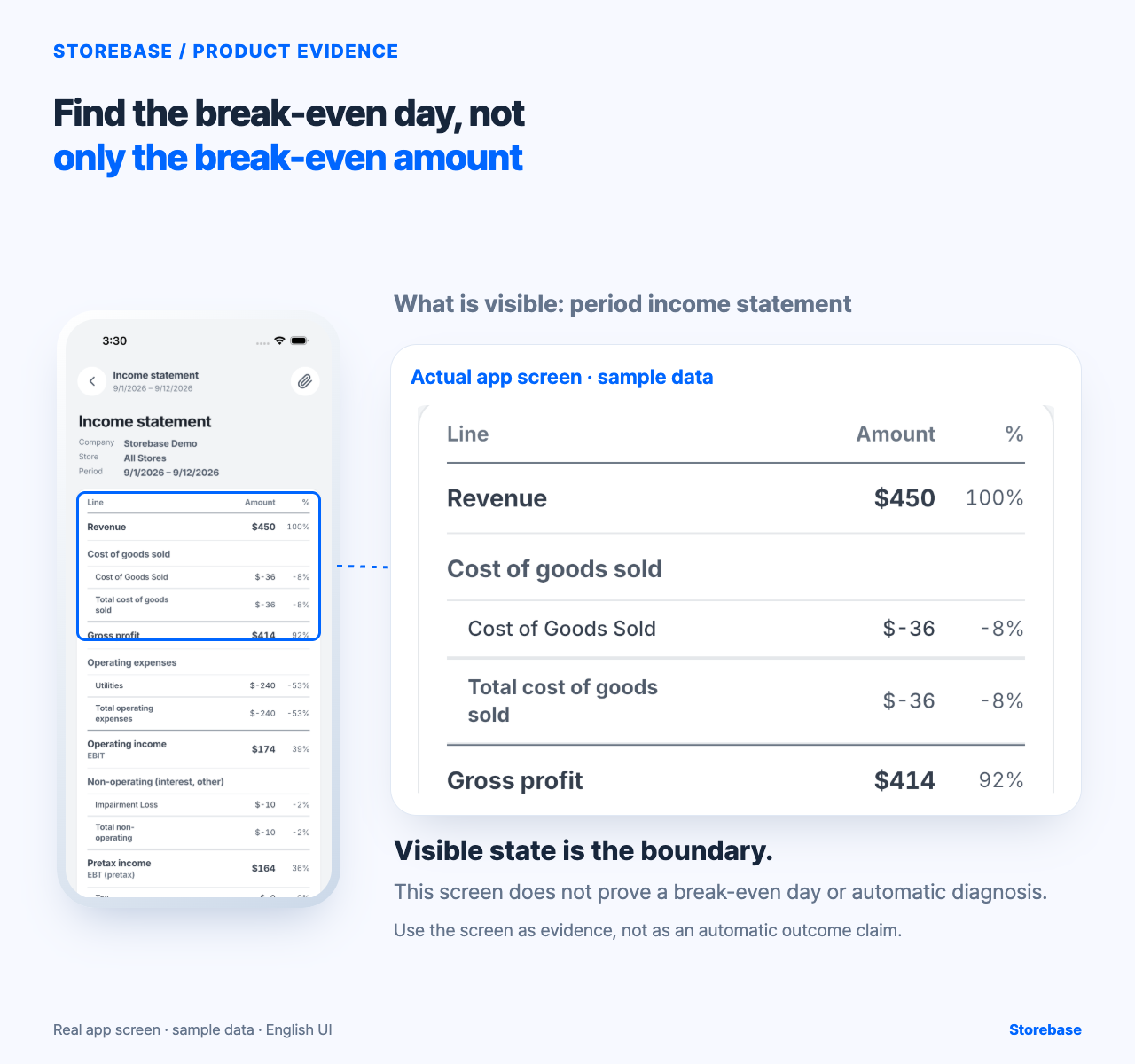
Where Storebase can contribute
Storebase’s centralized finance description puts store, company and group numbers together so branches can be compared. That can reduce the time spent merging separate daily figures before an owner starts the break-even review. Use the shared view to identify which branch and period need attention, then make the assumptions visible in the calculation.
The product material does not establish a dedicated break-even calculator or prove that a reported date is correct. It also does not decide whether fixed costs, historical cost basis, returns or tax items were classified correctly. A bookkeeper or accountant should review the method when the result affects reporting, pricing or a major decision.
A monthly routine
- Choose one store or company and one calendar month.
- Write the fixed-cost and variable-cost definitions beside the calculation.
- Pull comparable sales and cost inputs for each day.
- Calculate cumulative contribution and mark the first date that crosses the fixed-cost line.
- Test the result against returns, discounts, unusual purchases and missing entries.
- Compare branches only after their definitions match, and save the assumptions with the result.
Use the date to choose the next question
If the date moves later, ask whether sales slowed, margin narrowed or a fixed cost rose. If two branches differ, ask which input differs before declaring a performance problem. If the result cannot be reproduced by another person, repair the inputs and definitions rather than presenting a precise-looking date.
The conditional benefit is shared understanding: a calendar can help a team discuss when the month covered its stated costs. It is not a guarantee of profit, cash availability or tax treatment. Recheck the date next month with the same definitions and ask a second person to explain what changed.
Mark the date as provisional until late entries are closed
A break-even day can move even when store operations did not. A supplier invoice posted late, a return entered after the review, or a payroll allocation moved to the correct branch can shift the crossing point. For that reason, save the calculation date, data cutoff, included stores, costing method, and assumption version beside the result. Label an in-month answer as provisional; label it closed only after the agreed late-entry window and review are complete.
Keep revisions rather than replacing the earlier date. If the estimate moved from the 19th to the 22nd, record which input changed and whether the change corrected missing data, updated an assumption, or reflected new operating activity. Those explanations lead to different decisions. A data correction calls for a better input process; a margin change may call for pricing or mix review; a new fixed commitment affects the cost base. Without version history, the calendar looks simple but conceals the cause.
Also test whether the cumulative contribution stays above the cost line through the cutoff. Crossing once and falling below after returns or adjustments means there was no stable crossing under the final inputs. This prevents the team from celebrating a date that existed only because the most inconvenient entries arrived later.
Use the day to choose a lever, then test the lever separately
Turn a later date into a bounded question rather than a general verdict on the store. Recalculate three views with the same period: the recorded case, a lower-margin case, and a case with one identified fixed-cost change removed or added. These are planning scenarios, not forecasts. Their purpose is to show which assumption has enough influence to deserve investigation.
Give each candidate lever its own evidence and owner. A sales-volume question needs daily transaction evidence; a margin question needs item cost, discount, and return treatment; a fixed-cost question needs the agreement or allocation that created the charge. Change one operating action for one period, then compare the next provisional and closed dates under the same definitions. Do not claim success merely because the date moved earlier if the move came from delayed costs or a new assumption.
Storebase can help gather branch-level figures into a comparable view, within the limits already stated in the article. It does not establish the assumption set, freeze the input cutoff, or certify the resulting day. The owner’s useful outcome is a shared, reproducible question that a manager can investigate, while accounting judgment and material pricing or investment decisions remain with qualified people.