
STOREBASE INSIGHTS · Sales and finance
When a receipt looks wrong, compare it before accusing anyone
Keep the receipt and transaction together, compare the photographed or attached amount with the ledger entry, and flag the difference for a person to review. A flag is a question, not proof that a receipt is fake or altered.

On this page
A flag should open a question
A receipt that is larger than the ledger line, appears twice, or looks inconsistent deserves a review. It does not deserve an accusation before the source documents and transaction context are compared. The owner’s useful goal is to make the first question visible without reading every receipt manually.
Keep the original image or document, the transaction line and the reason for review together. Check whether the difference comes from tax, a tip, split payment, timing, duplicate upload or a genuine mistake. Record what was checked and who decides the next action.
Review the difference in order
| Check | Compare | Possible explanation |
|---|---|---|
| Amount | Receipt and ledger line | Tax, tip, split or entry error |
| Date | Receipt, purchase and posting dates | Period timing |
| Vendor | Name and account | Similar suppliers or duplicate import |
| Document | Image, invoice and approval | Missing page or unsupported charge |
What Storebase can contribute
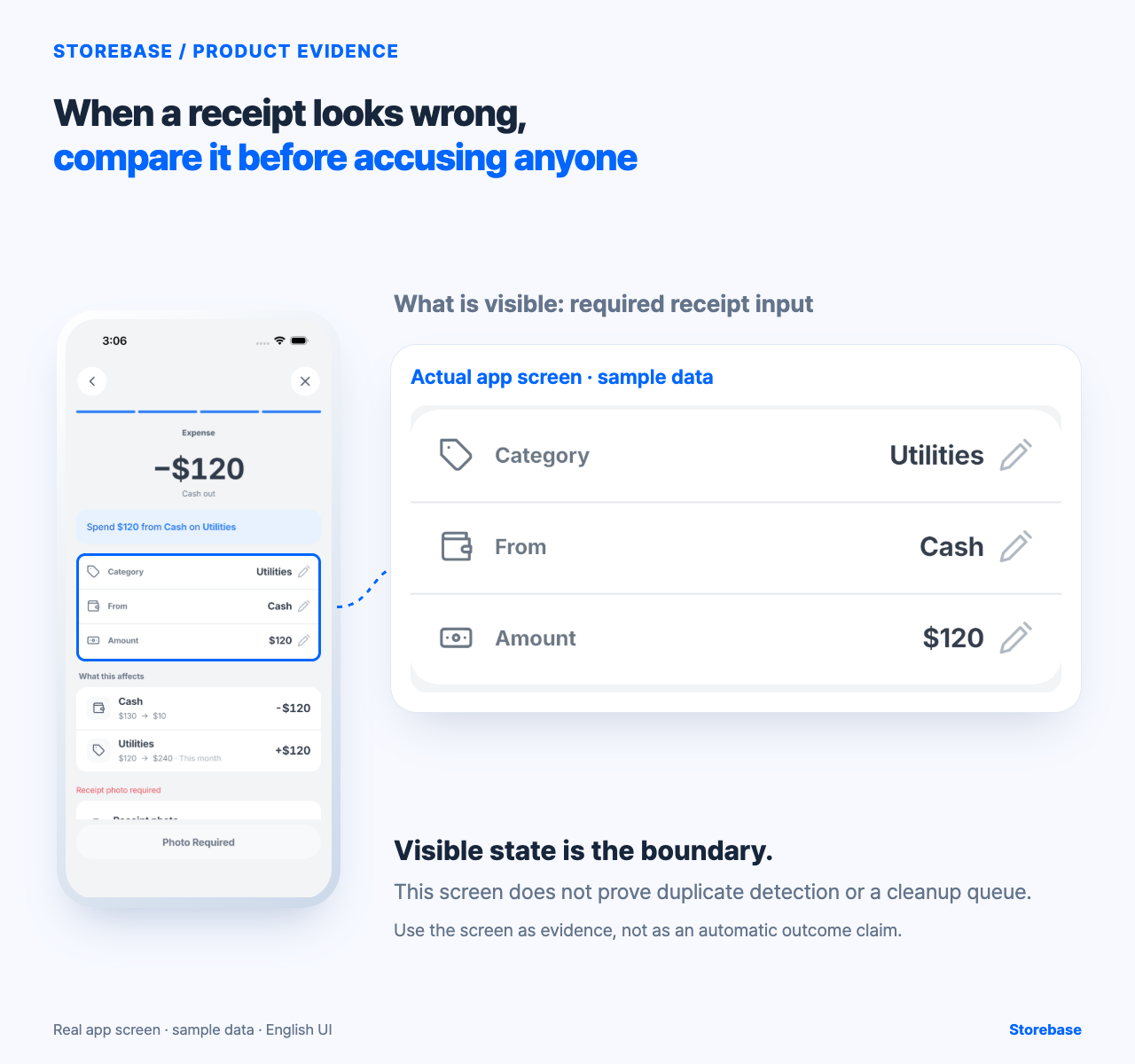
Storebase’s receipt and transaction records can be compared so a difference is brought forward for attention. Treat that as a review prompt. The available evidence does not prove that every image is authentic, that a model can decide fake or doctored documents, or that a flag is a fraud finding. A person must inspect the receipt, purchase and approval.
A safe exception routine
- Preserve the original transaction and receipt.
- Compare amount, date, vendor and account.
- Mark duplicate, unclear, corrected or unresolved.
- Assign the review to someone with authority.
- Record the explanation and any correction without erasing the original story.
After a month, sample flagged and unflagged entries. Ask whether the reviewer can explain why each was flagged and what evidence settled it. If not, improve the input or review rule. For accounting, tax and disputed expenses, obtain qualified local guidance.
Keep one receipt comparison open
When two uploads look alike, compare the vendor, date, amount, account and the actual files before changing either transaction. Keep both records while the reviewer decides whether they are duplicates, a split purchase or two legitimate charges.
Sample a cleared and an unresolved pair
Choose one pair that was cleared and one still open. A reviewer should be able to say which fields matched, what source document was checked and why the decision was made. A flag is useful only when it leads to a documented human decision.
Treat a close match as a case, not a conclusion
Two receipts can share a supplier and total without representing the same purchase. A recurring delivery may use the same template, a card charge may combine several slips, and a corrected document may retain the earlier reference. The root failure is therefore not simply weak detection. It is a review process that collapses a similarity signal, the supporting transaction and the final decision into one label. Once that happens, a useful prompt becomes an unsupported allegation and the team learns to distrust future alerts.
Open a case with a stable reference to both files and the ledger lines they may support. Add the purchase purpose, payment reference, location, submitter, approver and any correction already made. The reviewer should then choose among distinct outcomes: the same evidence was attached twice; one purchase was divided across records; the merchant issued a replacement; the transactions are separate; or the available material cannot settle the question. An unresolved outcome is legitimate when the evidence is incomplete. It should carry a next action and an owner rather than being forced into a duplicate category.
The product evidence is narrower than the full routine. Inspected source shows analyzed receipt attachments presented as structured fields with a verification status. It does not establish a public-safe comparison screen, immutable history, actor attribution or a fraud verdict, and a controlled runtime result is still needed. Use Storebase to surface the recorded fields that are actually available in your workspace; keep authenticity, business purpose and corrective action with an authorized human reviewer.
Calibrate the rule with decisions that can be challenged
Pilot the rule on a closed batch from one store before making it part of routine approval. Hide the old outcome from the reviewer, retain the rule version that produced each signal, and require a short decision note tied to the source material. The point is not to maximize the number of warnings. It is to learn whether the same evidence leads another qualified reviewer to a defensible disposition without calling the submitter for missing context.
Include ordinary recurring purchases as well as suspicious-looking pairs. A rule that finds only dramatic examples can still create noise on routine supplier documents. When reviewers disagree, inspect which fact was missing or which threshold was ambiguous; do not settle the disagreement by deleting one record. Revise the input requirement or the review instruction, then rerun the disputed cases under the new rule while retaining the earlier result.
The regression gate is simple: a cleared pair must remain explainable, a genuinely repeated attachment must still reach an accountable reviewer, and an open case must not silently disappear from the queue. The owner should receive only cases that cross the store's authority or risk boundary. If every similarity still needs the owner to reconstruct the purchase, the process has merely moved manual checking to a different screen.
Related resources
Explore Storebase financial reports and record-keeping
Turn receipt cleanup into a routine before the backlog grows