
STOREBASE INSIGHTS · Sales and finance
Correct an old transaction without rewriting the story
Give correction access only to the people who need it, keep the original entry visible, and record why a change was made. A permission boundary protects the working record; it does not decide whether the correction is proper accounting.

On this page
Old records need a boundary
A correction can be necessary without giving everyone permission to rewrite the working record. A bookkeeper may need to protect a prior-year entry while a tax preparer receives read-only access. The practical question is who can correct what, in which period, and how the original explanation remains available.
Separate entry, review and correction authority. A person who sees an error should be able to raise it; the person with the right authority should decide the correction. Keep the original transaction, reason and date visible according to your policy.
Make the boundary explicit
| Situation | Access question | Follow-up |
|---|---|---|
| Recent entry by its creator | Can the creator correct within the allowed window? | Check the reason and result |
| Older entry | Who may change it? | Preserve the original and approval |
| Another person’s entry | Is permission required? | Escalate rather than overwrite |
| Closed period | Is it locked for reporting? | Ask the accountant before changing |
What Storebase can contribute
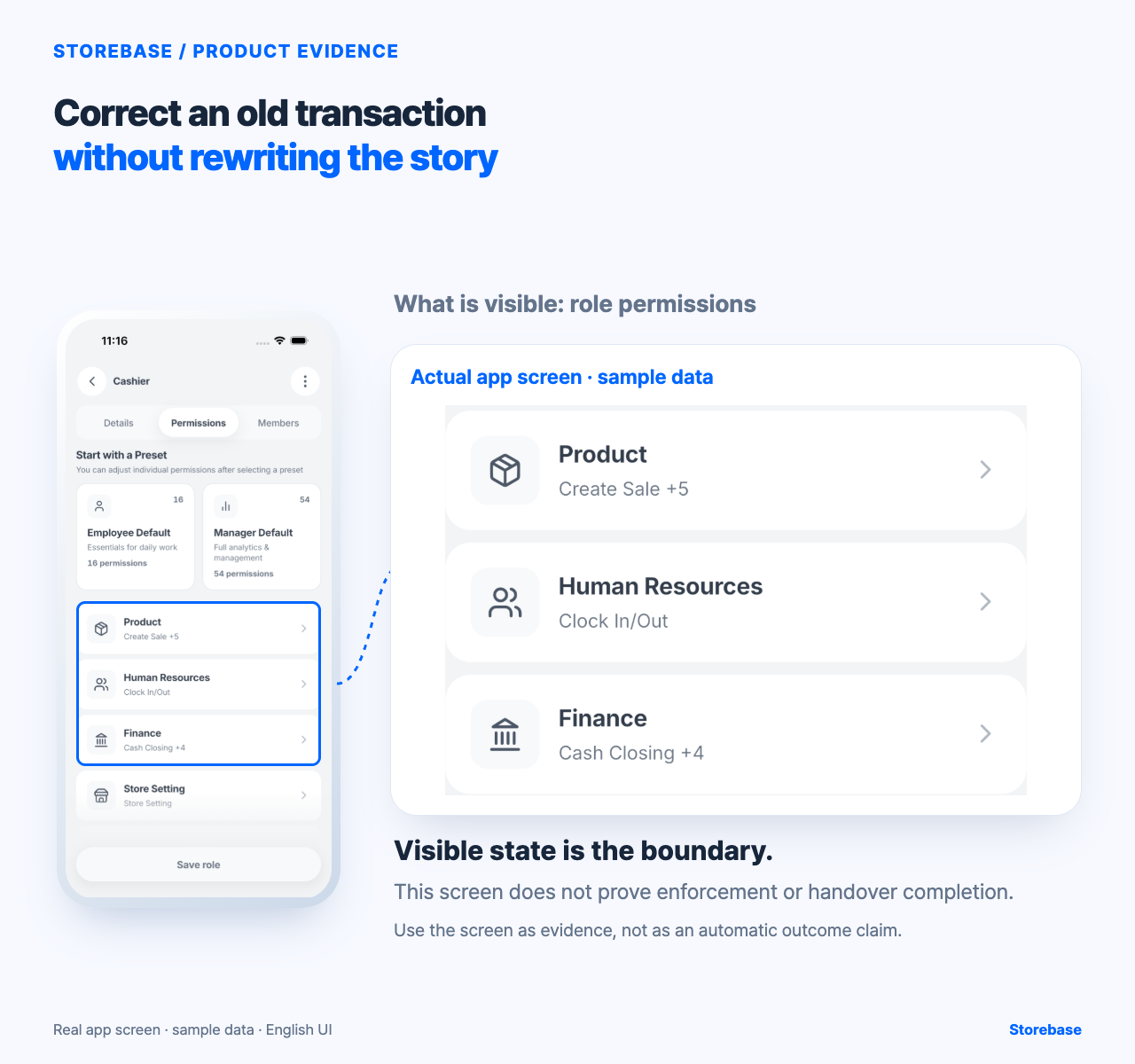
Storebase’s permission model distinguishes cancelling another person’s entry from correcting one’s own entry within a limited window, while a cancellation can remain as a reversing record instead of disappearing. Use this as an access question, not a promise about your legal books. Before relying on this boundary, test the actual permission and reversal behavior in a controlled account.
Before changing an old record, preserve the report, source document and reason. Ask the responsible accountant whether a correcting entry or reversal is appropriate.
Check the result
Choose one recent and one old correction. Can an authorized reviewer see who made the change, why, and what the original entry was? If not, repair the policy and handoff. Permissions can return time to the right people; they do not replace reconciliation, retention rules or professional accounting judgment.
Keep a correction trail open
For one old transaction, record the original date and amount, the reason for the proposed correction and the person who must approve it. Keep the old entry available while the question is open. If the permitted action or reversal behavior differs in your account, stop and ask the responsible accountant before relying on it.
Verify one recent and one older change
Ask an authorized reviewer to compare one recent and one older correction. They should be able to identify the original, the reason and the resulting entry. If the history or access rule is unclear, document the uncertainty instead of deleting the trail.
Separate the request, authorization, execution and reconciliation
A permission setting answers who may perform an action; it does not show that the proposed action is justified. Build a correction packet before anyone touches the record. It should identify the mistaken assertion, the source evidence that contradicts it, the affected period and reports, the proposed treatment, the requester, the approver and the person who will execute it. Keep those roles distinct where the store has enough people, and document the compensating review when one person must hold more than one role.
Freeze the relevant report or export before the change so the team has a baseline. After execution, attach the resulting entry or reversal and explain which balances were expected to move. This turns an old correction into a traceable claim: the source showed one fact, an authorized person chose a treatment, a specific action changed the records, and a reviewer checked the consequence. Without the last link, a visible history can still contain a correction that never reached the report it was meant to repair—or reached it twice.
Storebase source evidence establishes only a partial boundary: the reviewed transaction interface code passes a permission identifier through a refusal path for cancellation. It does not yet prove runtime denial, immutable correction history or the accounting result. The catalogue also describes a limited window for a creator's own cancellation and a reversing record, but those behaviours must be verified in a controlled account before operating policy depends on them.
Reconcile every downstream use before closing the case
List where the old entry has already travelled: management reports, supplier balances, tax workpapers, bank reconciliation, inventory value, partner statements or an exported spreadsheet. Not every correction affects every destination, but every relevant destination needs an explicit decision. Mark it unchanged with a reason, refreshed from the corrected record, or handed to a qualified adviser. Sending a new export without naming the superseded version creates a second source of truth rather than repairing the first.
Use a narrow regression test. In a controlled account, attempt the same correction as the intended operator and as a role that should not have authority. Confirm the permitted or refused action against the policy, then verify that the pre-change entry, explanation, resulting record and affected report can all be traced. Repeat the report or export once more without making another correction; its result should not apply the effect again. If any link is ambiguous, keep the case open and restrict wider access until the behaviour is understood.
For the owner, the useful outcome is delegated correction without delegated amnesia. Ordinary mistakes can be handled by the people closest to the records, while a closed period, disputed evidence or high-consequence treatment rises to the appropriate reviewer. The owner then decides exceptions from a complete trail instead of becoming the only person allowed to repair every historical entry.
Related resources
Explore Storebase financial reports and record-keeping
When a receipt looks wrong, compare it before accusing anyone
When sales are posted late: keep the sales day separate from the record time