
STOREBASE INSIGHTS · Sales and finance
Let staff check their own record before a discrepancy becomes an argument
Show each person the information they are allowed to see, invite them to check the record, and discuss the specific discrepancy rather than a manager’s memory. Visibility can make a correction less personal; it does not rank people or guarantee performance.

On this page
Let the person see the record
When a manager points out a problem and the worker can see only the manager’s conclusion, correction can sound like a personal attack. A better first step is to show the information the person is allowed to see and ask them to check the same record. Talk about the specific date, entry or discrepancy, not a vague judgement about character.
Visibility does not mean exposing private pay or ranking everyone. It means giving the worker enough of their own operational record to understand what is being discussed and what action is needed.
A conversation with a shared starting point
| Step | Shared record | Human decision |
|---|---|---|
| Show | The person’s permitted information | Confirm privacy and access |
| Check | Date, entry or attendance event | Ask for context |
| Correct | The concrete discrepancy | Decide the next action |
| Follow up | The same record later | See whether the issue changed |
What Storebase can contribute
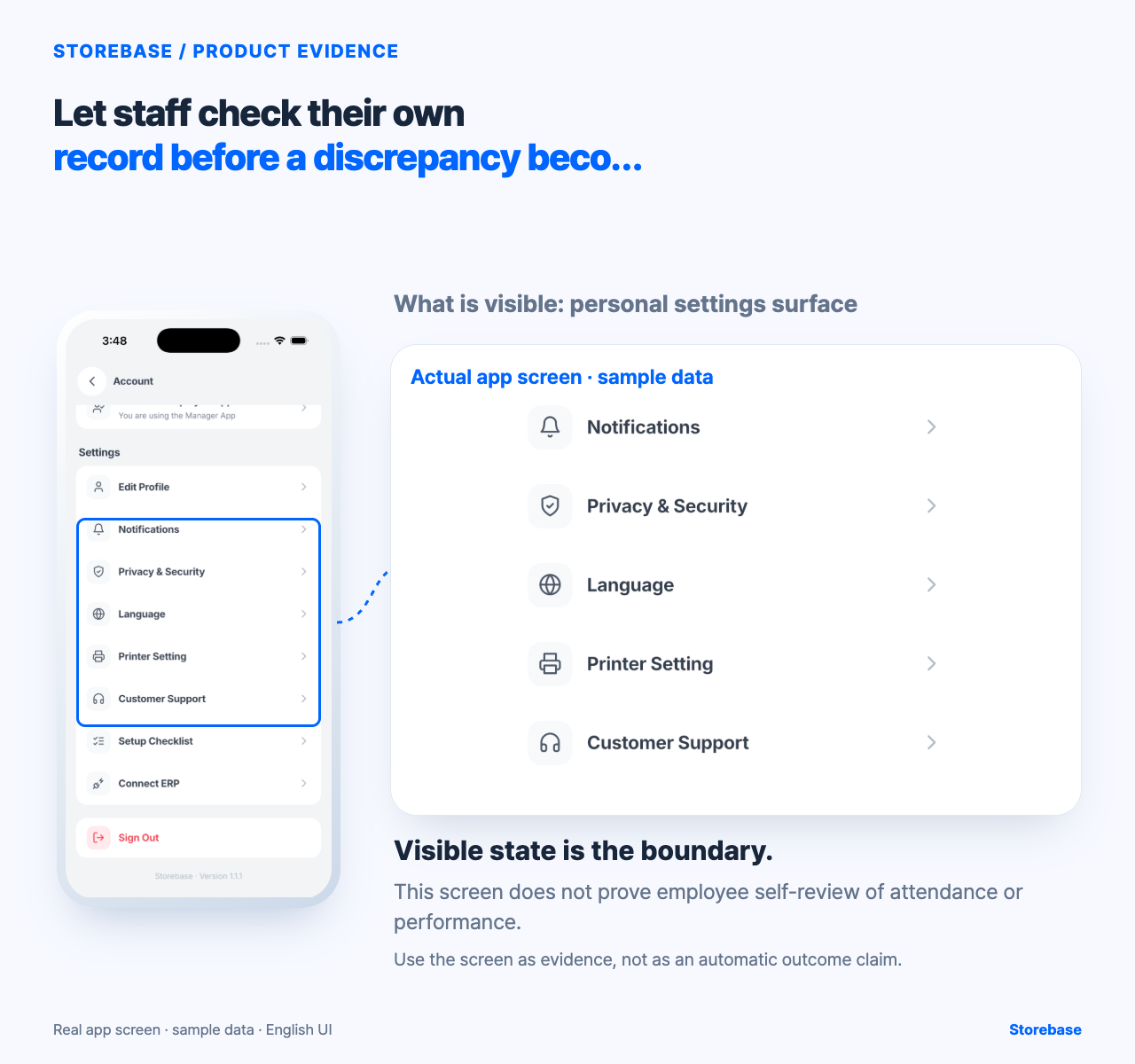
Storebase’s My Page gives a person a place to review the profile and settings information available to that account. Use that page only as a shared starting point; it does not establish a complete performance record, ranking or pay decision.
Give access only to information the person should see. Do not publish another worker’s data or infer motive from one entry. If the record is wrong, correct it through the responsible process and keep the explanation.
Check the result
At the next discrepancy, ask the worker to locate the same date and describe what they see before discussing blame. If both people can name the record, the missing context and the next action, the conversation has a better starting point. If not, repair the record or access rule. This can reduce personal friction; it is not a promise of better performance or an objective verdict.
Keep one staff question open
For one attendance or schedule discrepancy, let the worker check the date and permitted record on their own page. The manager can then check the same approved item and write down who will correct it. Do not expose another worker’s information or turn one entry into a performance score.
Check the next conversation
At the next review, ask the worker to name the date, value and missing context before discussing cause. The check is useful when both people can point to the same record and agree on the next owner; it is not a verdict on the person.
Prepare a review packet before asking for an explanation
A fair self-check starts with a record the worker can actually inspect, not a summary written after the manager has reached a conclusion. Preserve the original event, the applicable rule or schedule version, the source that produced the value, and any later correction as separate elements. Then frame one neutral question: which element is wrong or missing? This lets the employee confirm the event, add context, or challenge the source without having to defend their character. If the manager cannot identify where the value came from, the item is not ready for a conduct or pay conversation.
Give the employee a defined response path. Record whether they agree, dispute the event, accept the event but question the rule, or supply evidence that was unavailable at first. Name the person who will examine a dispute and the point when both sides can see the outcome. The original value should remain distinguishable from the corrected value so the review does not become a contest between screenshots. This is not an employee vote on every management decision. It is a way to keep factual correction, policy interpretation, and managerial judgment from collapsing into one accusation.
Verify symmetry, privacy, and the Storebase boundary
Before using any self-service view in a real review, run a paired test with a non-sensitive sample. Ask the worker and the authorized manager to locate the same permitted item independently. Check whether the date, label, status, and correction route mean the same thing to both people. If the worker can see a number but cannot identify its source or report an error, visibility has not yet created a usable handoff. If the manager sees private material that is unnecessary for the discussion, narrow the review surface rather than copying it into a shared message.
The verified Storebase evidence for My Page covers profile and settings information available to an account. It does not demonstrate that attendance events, rankings, wages, disciplinary findings, or a complete correction history are shown there. Do not direct a worker to search for evidence that the inspected product surface has not been shown to provide. Use My Page for the account information it actually exposes, and bring any separate operational record through its authorized process. The result check is modest: both people can identify the same admissible fact, distinguish an unresolved challenge, and know who owns the next step. When that works, the owner can leave routine corrections to a consistent process while retaining only privacy, policy, or authority exceptions.
Related resources
Explore Storebase financial reports and record-keeping
When a receipt looks wrong, compare it before accusing anyone