
STOREBASE INSIGHTS · Sales and finance
Why every store payment needs a clear handoff
Keep the requester, receiver, counterparty, source document and approver visible as separate handoff facts. A named record can save the owner a repeated lookup; it does not replace checking the order, goods, invoice or approval.

On this page
- Why the owner keeps rebuilding the history
- Give each person one clear handoff
- What Storebase can contribute
- A payment handoff that survives absence
- Check one ready payment and one exception
- Give each payment a state that cannot be mistaken for approval
- Rehearse the exception path with a deliberately incomplete packet
Why the owner keeps rebuilding the history
A store payment can be ordinary and still consume the owner’s time. One person knows who requested it, another remembers what arrived, and a third has the invoice or bank detail. If those records are not connected, the owner becomes the handoff: every payment asks for its history again.
The better question is not “Can the owner approve this from memory?” It is “Can the next reviewer see who did the work, whether the goods arrived as expected and why the money is owed?” That is a record-design question. It does not require staff to become accountants; it requires each person to leave the part of the story they actually know.
Give each person one clear handoff
| Person or event | Record to leave | Next decision |
|---|---|---|
| Requester | What was needed and for which store | Is the request still valid? |
| Receiver | What arrived, when and in what condition | Does the received quantity need explanation? |
| Reviewer | Counterparty, amount and source references | Is the payment ready for approval? |
| Owner or approver | Decision and unresolved question | Who checks the next exception? |
Keep the original request, receiving note, invoice and payment context available. A named supplier or counterparty helps another person find the right record, but it does not prove that the order was placed, the goods arrived, the invoice is correct or the payment was approved. Those checks remain part of the handoff.
What Storebase can contribute
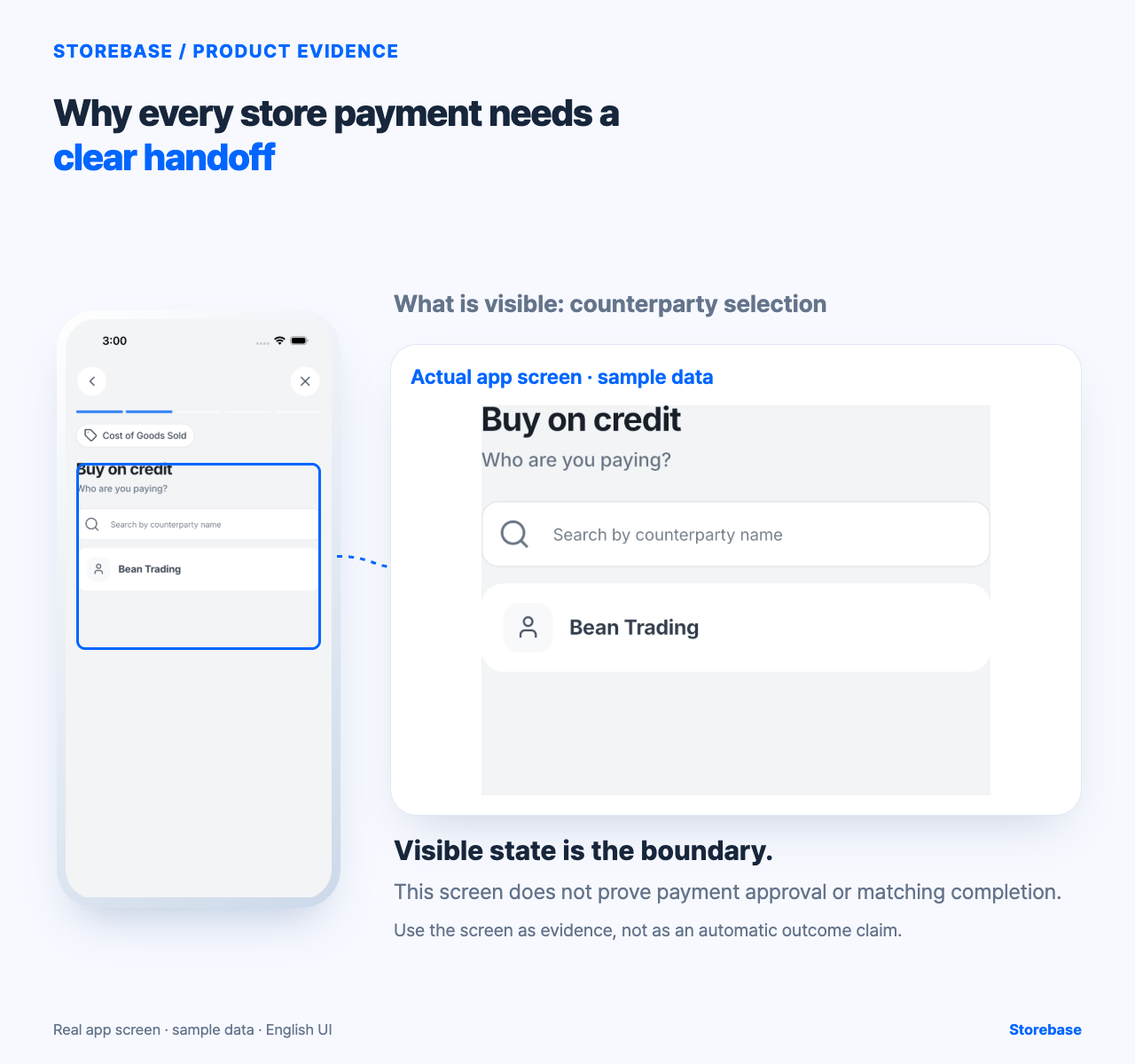
Storebase’s counterparty selection gives a transaction or debt entry a named context, and the transaction-history view gives a place to return to prior records and filters. That can shorten the first lookup when the owner asks who the payment concerns and where its context starts. Use the name and history as a starting point for the handoff, not as an approval decision.
The inspected counterparty picker does not show a complete order-to-receiving-to-invoice chain, an immutable debt ledger, automatic matching, collection status or approval. The useful action is locating and naming the record; a person still checks the source documents and the received goods.
A payment handoff that survives absence
- Write the store, counterparty and purpose before the payment question reaches the owner.
- Ask the requester to leave the order or request reference.
- Ask the receiver to record what arrived and flag a quantity or quality difference.
- Return to the named transaction or history entry and attach the invoice or source reference available to the team.
- Mark the unresolved question and the person who can answer it.
- Let the authorized approver decide after the record is understandable; do not turn a missing document into an automatic “approved.”
The aim is not to remove judgment. It is to move the owner’s judgment to the decision that actually needs it instead of making the owner reconstruct every earlier step.
Check one ready payment and one exception
At the next payment run, choose one payment that moved smoothly and one that needed a question. Can another reviewer identify the counterparty, requester, received quantity, source document, amount and approver without calling the owner for the whole backstory? If yes, keep the same handoff. If no, repair the missing record at the step where it disappeared.
The benefit is a shorter path to the right decision when the owner is away. It is not proof that every supplier record is complete, that goods were received, that a payment is lawful or that accounting and tax treatment is correct. Keep the original documents and obtain qualified local accounting guidance when the distinction affects the books.
Give each payment a state that cannot be mistaken for approval
A useful payment handoff says where the item is in its journey, not only who the supplier is. Define a small set of operational states in the team's own procedure: submitted, evidence incomplete, ready for authorized review, approved, executed, and reconciled or closed. Each transition should name the person who made it, the time, the source evidence considered, and the next owner. A note such as “checked” is too vague because it may mean the goods were counted, the arithmetic was reviewed, or the bank transfer was sent.
Keep approval distinct from execution. An approved item can remain unpaid; an executed transfer can still await bank confirmation or ledger reconciliation. If a request is cancelled, duplicated, split, or replaced, connect the successor and record why the original stopped. Never erase an awkward record merely to clean the queue. This state discipline blocks two common reconstruction traps: paying the same obligation through two versions of the request, and assuming a visible transaction proves that the underlying goods and invoice were accepted.
Rehearse the exception path with a deliberately incomplete packet
Before the next payment run, prepare a safe sample with one essential element missing—for example, the receiver has recorded a quantity difference but the person who can explain it has not replied. Hand it to a reviewer who was absent from the purchase. The correct outcome is not approval by guesswork; it is a visible hold, a named question owner, and a clear condition for resuming review. Then add the missing response and confirm that the reviewer can continue without the owner retelling the purchase.
Storebase can contribute a named counterparty context and a transaction-history return point. Current evidence does not establish an automatic chain among order, receipt, invoice, approval, payment, and reconciliation, nor does it prove an immutable payable ledger. Keep the original documents and human decision gates around those views. If another reviewer can locate the record, recognize its current state, and see exactly why it is blocked, the handoff is doing useful work. The owner's time is then reserved for unresolved authority or commercial judgment rather than routine historical reconstruction.
Related resources
Explore Storebase financial reports and record-keeping
Checking supplier invoices: match the order, receipt and bill
When cash moves from the till to the bank, leave a handoff record
Let staff check their own record before a discrepancy becomes an argument