
STOREBASE INSIGHTS · Sales and finance
Supplier balance disputes: build a shared record before arguing
When a supplier’s balance differs from yours, do not overwrite the total first. Align the cutoff date, opening balance, invoices or receipts, returns or adjustments, and payments. Find the transaction where the two records diverge.

On this page
Are the totals comparable?
One party may include this week while the other stops at month-end. A payment may be allocated to a different invoice, or a return may appear on only one side. Exchanging totals alone does not identify what needs checking.
Reconcile the underlying movements
| Item | Supporting record |
|---|---|
| Opening balance | Previously agreed date and amount |
| Increases and reductions | Invoice, receipt, return or adjustment |
| Payment | Date, amount and invoice allocation |
Mark unresolved entries separately. Assign the document request and a person to follow it up. A disputed balance is not a reason to duplicate a payment already verified.
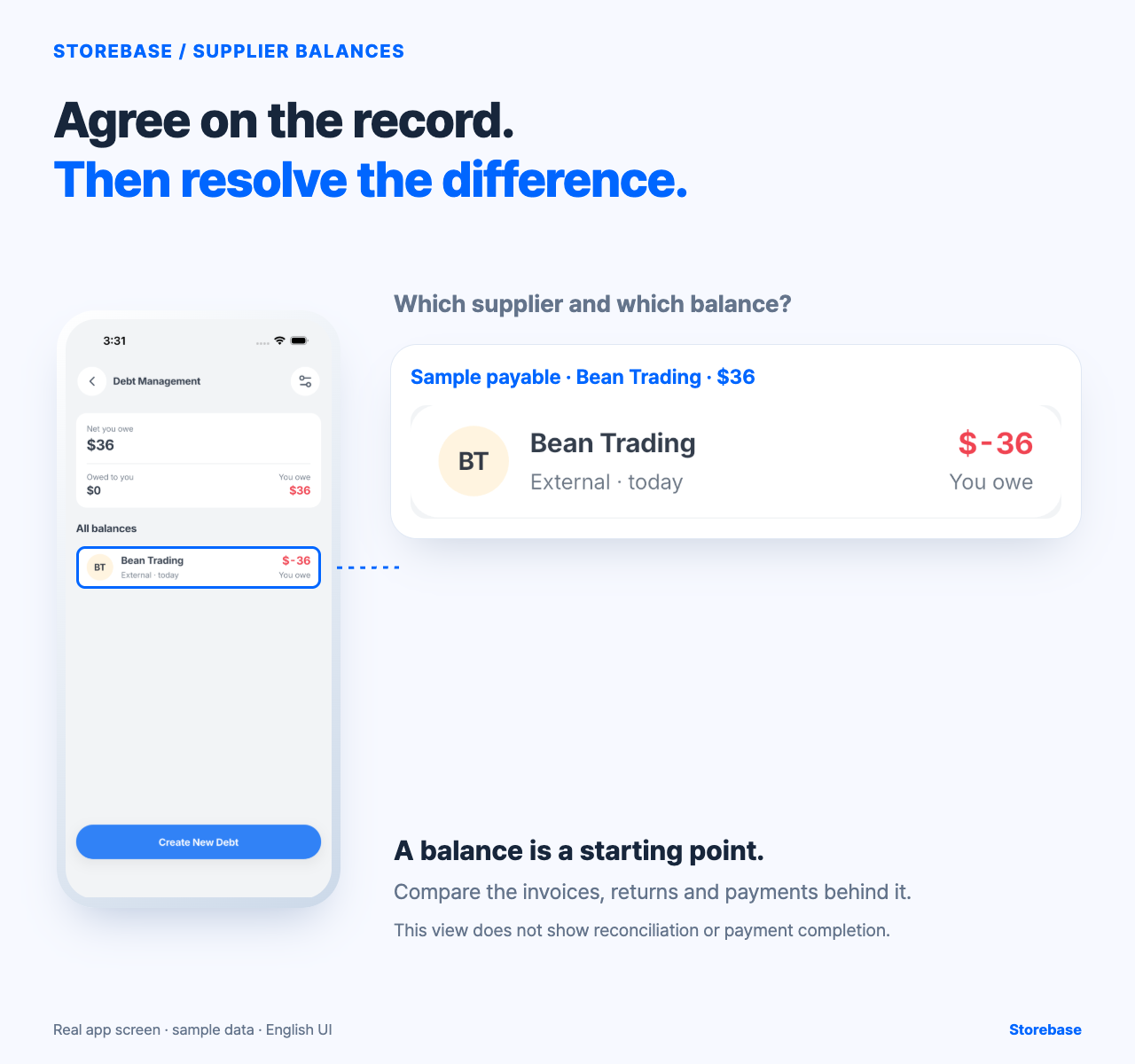
When a supplier disagrees with the balance, goodwill and memory are not enough: both sides need a shared transaction record. Storebase Debt Management shows the counterparty and whether the balance is owed to or by the store; the Bean Trading $36 view is only a sample starting balance. Use it to compare invoice, payment and return records. It does not prove automatic matching, an agreed balance, settlement, or complete transaction history.
Preserve the new shared starting point
Record which transaction was corrected and why, then retain the date on which both sides confirmed the balance. Separate contractual or tax questions for qualified review; this is not a determination of legal liability.
With an agreed reference, the next person can continue from the records rather than asking the owner to reconstruct the history from memory.
Build a common balance bridge before arguing about the total
Turn the disagreement into a bridge that both sides can reproduce. Give the exchange a fixed cutoff and currency, then list the opening position, each document that increased the balance, each credit or return that reduced it, and every payment with its value date and reference. Preserve the supplier's version beside the store's version; do not edit either source to make the columns line up. A difference then becomes a specific missing, duplicated, misdated, misallocated or differently interpreted event rather than a claim that one total is simply wrong.
Mark the portion that both parties support separately from the contested portion. That distinction lets the owner see the size and age of the decision without treating the entire relationship as uncertain. It does not itself authorize paying, withholding, netting or renewing credit. Those choices depend on the agreement, approval authority, cash position and applicable accounting or legal advice. The operating record should expose the question and its owner, while the authorized person decides the commercial response.
Package each open item with the source document, the explanation requested, the person expected to answer and the next review date. If the store believes a transfer was applied to the wrong invoice, include the transfer evidence and both invoice references instead of sending a vague request to check the account. If the supplier relies on a charge the store has never received, ask for that document without manufacturing an internal entry. Precise requests shorten the evidence loop and keep a disagreement from turning into a general accusation.
Close the case in a way that survives the next statement
A verbal agreement is not a durable close. Record which line changed, which side changed it, the supporting credit note, corrected invoice, payment allocation or other source, the effective date and the people who acknowledged the result. Keep unresolved items open under their original identity; replacing them with a generic adjustment destroys the path a later reviewer needs. When a correction affects tax, contract rights or a financial period already reported, route that treatment to the qualified reviewer instead of presenting an operational checklist as an accounting conclusion.
Test the result against the next supplier statement. The corrected opening position should carry forward, an agreed payment should appear once, and a promised credit should either arrive with the expected reference or remain an explicit exception. If the bridge breaks again, reopen the exact item and inspect the handoff that failed—document intake, receiving, payment allocation or correction communication. Do not close an old exception merely because a fresh statement has moved the total.
For a bounded control, give one resolved case and its preserved sources to a second reviewer who did not negotiate it. Pass only if that person can rebuild the ending position, identify every remaining exception and state who owns the next action without asking what the final number was supposed to be. This test checks the quality of the record, not the legal validity of the supplier's claim or the fairness of a settlement.
Use Storebase as a starting ledger view, not as the other party's confirmation
The reviewed Storebase material supports viewing an amount owed to or owed by a named counterparty, and the debt workflow is described as providing counterparty-level state and settlement or offset actions. That evidence can anchor which relationship and direction the team is investigating. It does not establish that a supplier saw the same figure, that every invoice and remittance is present, that a suggested link is correct, or that an offset is contractually permitted. A screen value is the store's recorded state until independent documents and the supplier's response support something stronger.
Source review also leaves execution questions open. The available material does not prove end-to-end runtime persistence, complete debt semantics, automatic collection, payment completion or a safely retained settlement across every path. Before relying on the workflow, run a controlled case with known opening data, one increase, one reduction and one exception; refresh the record, inspect the resulting balance and confirm that no financial settlement occurred merely because the review action was saved. Keep the external statement and approval evidence outside the product record where the verified scope requires it.
The owner's gain is therefore conditional and specific. A structured counterparty view can point the team to the balance that needs explanation, while the shared bridge and assigned evidence requests keep the owner from reconstructing every exchange. Agreement, liability, accounting presentation and the decision to release money remain with the parties and their authorized advisers.
Related resources
Explore Storebase financial reports and record-keeping
How can a purchase order stay connected to what each store receives?