
STOREBASE INSIGHTS · Inventory management
How should staff record consumption and waste when stock moves?
Record consumption, giveaway and waste at the moment the movement happens, with item, unit, quantity, reason, store, actor and time. The record makes a later count explainable; it does not by itself prove every movement reaches financials or that a cost is current.

On this page
Record the movement when it happens
An empty shelf is rarely explained by the final count alone. A few bottles may have been used for service, given away, damaged or adjusted while nobody wrote down the event. Ask the person doing the work to record the movement at the source: item, unit, quantity, store, reason, actor and time. If the unit or reason is unknown, mark it for review rather than turning an unknown into a zero or a loss accusation.
Use reasons that describe the work, not a vague “adjustment.” Consumption, waste, giveaway, breakage, transfer and return are different questions. A short note can capture context: a tasting, a spoiled batch, a staff meal or a move to another store. The note needs to let the next reviewer connect the movement to the physical event.
Make later counts explainable
| Movement | Minimum record | Follow-up |
|---|---|---|
| Consumption | item, unit, quantity, actor and time | compare with service or usage |
| Waste or breakage | item, quantity, reason and evidence | review pattern and authorization |
| Giveaway | item, quantity, recipient context and approver | check policy and stock result |
| Transfer or return | from/to, quantity, reference and time | confirm the other location’s entry |
A movement log is not a license to post arbitrary numbers. The manager should review unusual quantities, repeated waste and entries made after the fact. The owner handles policy changes, material loss or a correction outside the manager’s authority. Preserve the original entry and document a correction rather than silently rewriting history.
Record and review a movement in Storebase
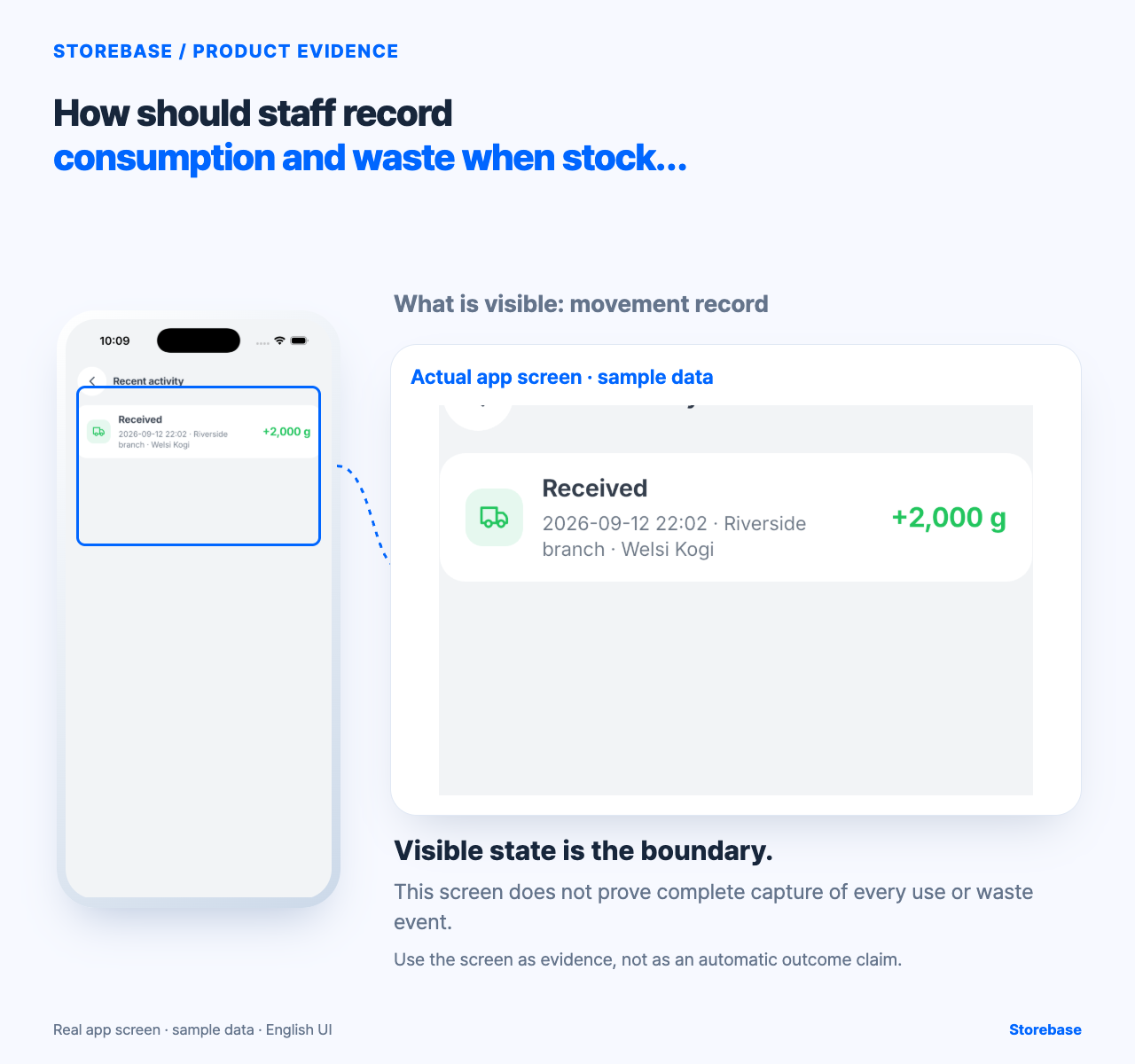
Use the movement record to revisit the item, movement type, quantity, store and time shown in the activity entry. Add a specific reason and any available note when the item was used, wasted, given away or moved, so the next count has a physical event to check.
Storebase can give the team a place to review a recorded movement. A visible entry does not prove that every use or waste event was recorded, that the financial posting is correct, or that the cost is current. Keep the operational record beside the responsible manager's accounting review.
Old cost can make a correct-looking movement produce a misleading financial result. Keep the operational movement record separate from the claim about profit. Before using a financial number, confirm the cost basis, period, store and correction status with the responsible accounting process. This article does not provide tax or accounting treatment.
Movement-at-source checklist
- Record the item, unit, store and quantity at the moment it is used, wasted, given away or moved.
- Name the actor and time; do not reconstruct them from a later count.
- Choose a specific reason and attach available evidence for waste or giveaway.
- Flag unusual quantities and late entries for manager review.
- Correct through a traceable adjustment that preserves what was first entered.
- Compare the movement trail with the next physical count and review the cost basis separately.
This is a source-time movement record, not a receiving-attribution workflow or a reorder threshold. If the person recording the movement lacks the right context or permission, stop and ask the manager before changing the stock. Check the physical event and the next count; do not use one visible entry as a complete waste log or accounting conclusion.
Start with one shift and one high-variance item. At close, ask whether another person can explain the stock difference from the recorded events without guessing. If not, improve the reason list, unit definition or handoff. The conditional benefit is a more inspectable stock story and earlier review of small losses—not a guarantee that shrinkage disappears, staff cannot make mistakes, or profit is automatically correct.
A small pilot
Use the next close as a small test, not as a performance verdict. Pick one reason that often arrives late, define its unit in plain language, and have the manager compare the source entry with the physical result. If the entry cannot be tied to a real event, preserve the uncertainty and fix the workflow before changing a financial number. This makes the record useful without turning it into an accusation.
Preserve event time and entry time as different evidence
A late entry can describe a real waste event, but it cannot serve as contemporaneous evidence. Record when the stock physically changed and when someone entered the movement as separate times. If the second time is later, keep the entry and mark the delay for review; do not backdate it to make the trail look clean. The reviewer can then ask whether the delay came from missing access, an unclear unit, a reason that did not fit, or a handoff that depended on one manager. Each cause calls for a different process correction.
Use three closure states. Captured means the movement has an item, unit, quantity, reason, location, actor and both times. Reviewed means an authorized person checked unusual size, late capture and supporting context. Reconciled means the next relevant physical check can account for the movement without an unexplained remainder. A displayed activity row can contribute the fields that are actually visible, but it cannot establish that capture is complete; nor does it demonstrate review, reconciliation, current cost or a correct financial posting.
For one recurring reason, compare the events that occurred during a shift with the entries available at close. Follow any late item to its next physical check and preserve the correction trail if the unit or quantity changes. The test fails when staff can make the count balance only by changing the occurrence time, overwriting the first entry or choosing a vague adjustment reason. It passes when a different manager can see what happened, why the record was late and whether the stock result reconciled. That is the point at which the owner can review an unresolved pattern instead of reconstructing every bottle, portion or damaged item. Apply these states at another store only after its team can classify the same evidence without relabeling earlier events.
Related resources
Explore Storebase inventory features and their scope
Why inventory doesn't match: fixing the number is only the start
How can a team split a stock count without counting the same shelf twice?